Chess! It already feels like a punishment to so many people! But now even more so! What if Zeus threw chess sets instead of lightning bolts?! What if Archimedes was a vengeful god?! What if you just kept getting chessed for eternity?!
Let's Play: Ancient Greek Punishment: Chess Edition is yet another new edition in the Let's Play: Ancient Greek Punishment series, focusing on a retelling of five (kind of) mythological punishments. In Chess Edition each punishment is expressed in the language of chess!
Timeline
Things notes
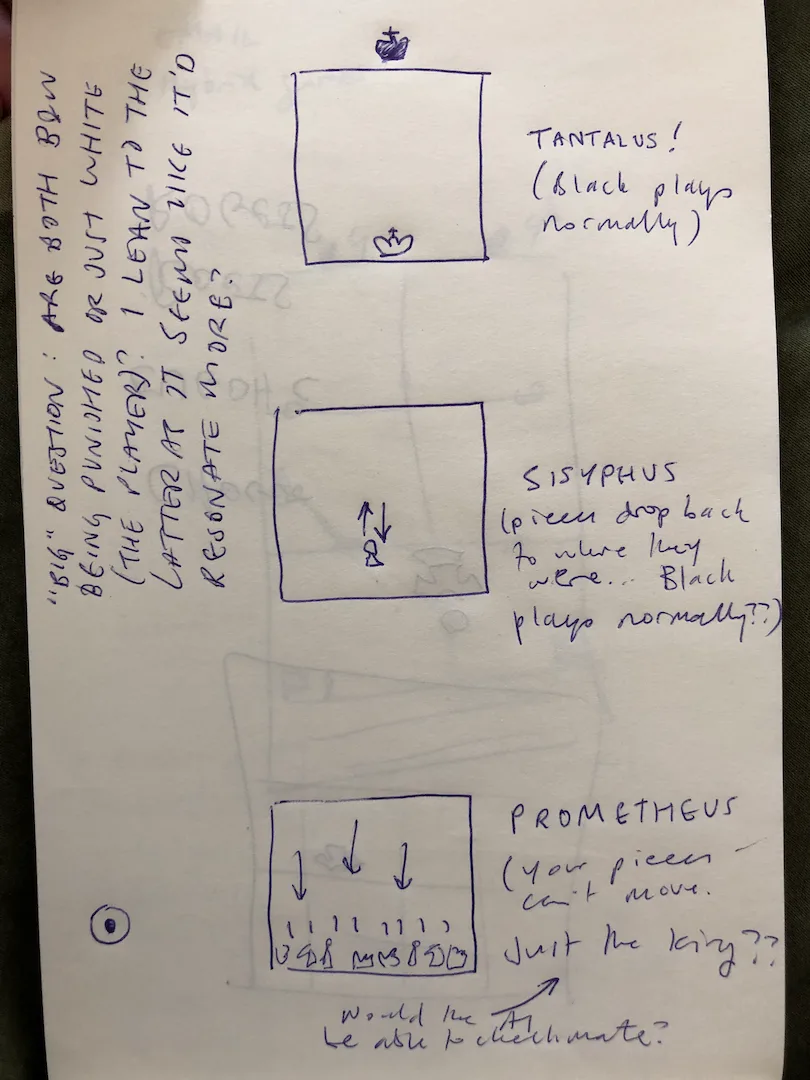
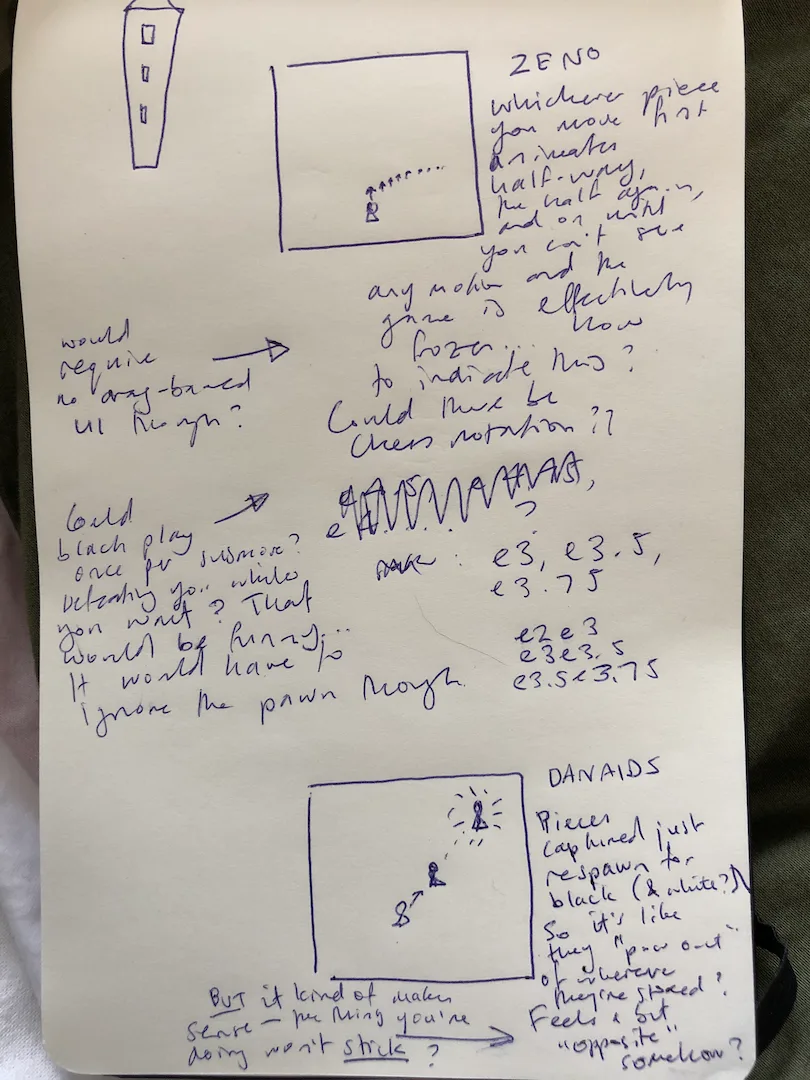
piece falls back at opening; opposing king is off the board; piece moves halfway over and over; you can’t move and king is captured over and over: danaids?
Notebook images
Chess + AI implemented, on with the specifics
This morning and this afternoon I've managed to get chess.js and chessboard.js working properly, as well as implementing a basic click-to-move setup rather than dragging (to avoid trouble with Zeno specifically). Also implemented the AI from that tutorial, got a version working where you can play white against the AI (it's not terrible, it's good enough that you can't just fuck around), and then got a version working where white can't move and black just plays on and on - because I was interested for Prometheus and Zeno as to whether black can win unopposed. It can. In 8 moves.
Black Checkmates Passive White

Actually slightly more efficient than I'd like? Is there some way to get a bit of variance in its moves? Otherwise it's going to look like a canned attack.
So that being the case, I have actual tasks ahead of me to implement the real games...
Sisyphus
The easiest one. Just need to revert the move (including animation... argh) after it is played, then play black's move. And on we go. As we know, black can win this in 8 moves. Will have to think about the issue of a Sisyphean move that involves a capture (need to undo the capture). I know the game system has an undo, so it's possible I just display the board, undo, and redisplay, and it'll take care of animations for me.
Prometheus
There's a decision to be made here about what white's situation is. In particular I already have the version where white is totally passive working (it's the build associated with this current journal entry in fact). But I'm wondering if we're just going to see that too often (Zeno involves unopposed victory for black, so does Sisyphus). For the sake of variety I might make it a white king against the full black set of pieces so you can "struggle" against it, while ultimately losing.
Zeno
This one will need to fake white's moves. As soon as they make their first move we animate halfway. But that animation should likely be jQuery rather than the board, we should just remove the piece altogether? (Unless it actually ends up on a valid square? For instance e2e4 starts with e3... that's awkward... although black won't be in a position to attack that square by then and after that it'll be too late). Then black continues to play. And we need to "hack" the PGN display so that we see the fractional moves white is making. Other than that it's a black victory unopposed, which would lead to the same 8 move checkmate as above with Sisyphus and Prometheus.
Tantalus
Can just set the board without Black's king (hoping it doesn't break the game engine's analysis stuff...). And then display the king just off the square so that you see it. Again this would likely just be jQuery displaying it in the right place (one tile's worth of y above the king's regular square).
Danaids
I haven't completely settled how the respawning works or if that's the right thing. But the point for now is restoring captured piece. I imagine it should be immediate, so you'd capture, there would be a beat, and then the piece would reappear... somewhere. The where is a bit tricky. Current best guess is as near as possible to it's point of origin, but I'm not sure how easy that would be to track? Guess it could be added to the data for each piece?
This reminds me that SFX would make a difference. Maybe even just steal the Chogue ones, which are nice. And a reverse capture sound for the restoration of pieces would be funny.
Structure
Okay, so I kind of feel like there's nothing too overwhelming lurking in there (pending some sort of disaster I just can't perceive lying in wait).
However there's the question of how to structure the code so this doesn't turn into horrible spaghetti bullshit. Buuuut there's also the whole idea of "just hack that shit together" instead. Buuuut I could also create a class representing a basic game of chess and then extend and override the parts needed to create my versions, which would be significantly cleaner.
I guess I lean toward a bit of structure. Okay fine. Fine. Yeah fine. Okay fine. Sure. Okay fine sure okay fine yeah okay.
Opening (ha ha)
Okay it's a new day it's a new dawn it's a new life it's a new ancient greek punishment game.
The thought here is to more fully remediate the original game as with UI edition by really switching to a totally new format (rather than a new input system or form of agency for instance). So here the idea is to represent all the punishments in the language of chess. Feels kind of ambitious, but I do have ideas for how to do it, and I suspect that both chess and the myths are "universal" enough that it ought to be at least somewhat possible. And anyway, the fun is in the process and then maybe MAYBE in the game.
Without further ado, here are my current thoughts on what to do...
Sisyphus
Player is white. Any move they place subsides back to where it started so it's impossible to actually play a move. Pawns slide back, knights slide back. That's the whole thing. Black never plays because white's move never sticks. And scene.
A different version (this will apply to more than one of these) would be that white's moves slide back but black plays on. I feel like that's a somewhat different idea though (more in keeping with Prometheus since you're literally being attacked while powerless to resist). So I suspect the totally passive version is best - and kind of punchier.
Prometheus
Player is white (or black?) and can't make any moves at all. Meanwhile the opponent plays normally, making moves and presumably ultimately defeating white.
Variation: as above, but white only has their king which they cannot move.
Variation: white only has their king but can move it around (equivalent to the "struggling" in the original game in this case). Question: would the simple AI I envisage implementing be able to defeat white in these scenario?
Tantalus
Player is white. Play proceeds normally but black's king just isn't on the board and so can never be checkmated, always out of reach. Perhaps more in keeping with the idea of the king as the "apple" you're trying to reach, but never reaching.
Variation: all of black's pieces are off the board so white is stuck playing their pieces meaningless on an empty board, unable to reach their opponent. Philosophically this one would be suggesting that part of the point of chess is the destruction of the opposing army, which is less pure than solely thinking in terms of capturing the king?
Zeno
Have been struggling with how to represent this one in a nice way. Thinking it may be plausible do it in chess notation? To some degree. So if you were to play e2e4 it would first play e2e3, then e3e3.5, then e3.5e3.75, and so on. A problem with this being the 53 (or so) move limit before you run out of floating point precision.
However, then the question would be: can the black AI defeat white unopposed in 53 moves? This would be a variation where black plays once per white's sub-moves. Weird-ish in that black then isn't subject to the same paradox, but that's also funny because it suggests white is Zeno and is punished for their stupid believes about the impossibility of complete motion. 53 moves unopposed seems like it should win? And if so then wouldn't actually need to worry about float point precision. Would have to test it out.
Danaids
This struck me as the hardest one because the original is the most involved of the myths mechanically (at least the way I represented it in the game, with the different stages of activity). However, if we just thinking about it as a situation where the substance you're "collecting" (water) continuously runs out of its container (the bath), then one conceptualisation here would be that each piece you capture of black's reappears on the board... i.e. flows out of wherever dead pieces are kept, back to its starting point.
There's a slight lack of clarity in terms of how to represent this happening. And also the question of where the piece would reappear. Where it was captured? Where it was originally from? A random free square? A random square near its spawn point? How to handle collections? How clear will it be to a player what is happening?
And now?
First task is just to implement chess and the chess AI from Lauri Hartikka to prove to myself I can interface with the two main libraries chess.js and chessboard.js (I used them for Best Chess). Then the big question will probably be just how hackable the process and representation of chess is in these libraries. The true horror would be having to actually implement a real chess representation of my own. That might be horrifying enough for me to back slowly away.
Let's see!
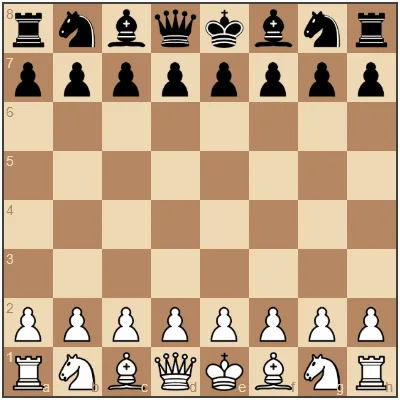
? It ain't much but it's more than there was. Totally non-interactive of course, but ladies and gentlemen we have a board.
? https://medium.freecodecamp.org/simple-chess-ai-step-by-step-1d55a9266977
? Remains to think about implementing positional tables for better play
? Remains to see whether this AI can beat me if I have my hands tied behind my back
? Even on a cursory examination, this version isn't stupid.
? This is to confirm black can win in under 53 moves, indeed it wins in... 8 moves. With a very impressive central attack culminating in a bishop checkmating the king. Nice to know this works.
? Just making sure I can display PGN in some capacity, and used this as the test case.
Some decisions
Having run the variations past Rilla last night (or was it this morning? Who can tell?) I want to record the directions I'll go in for each version quickly...
Sisyphus will be as is, you move your piece, it slides back, no move is registered, you never get past the initial attempt to move.
Prometheus will be the white king versus the full black set of pieces, you move the king around to "struggle" but ultimately must succumb presumably (will need to make sure black can win, but I'd be surprised if it couldn't)
In Zeno you move, the piece slides halfway, back moves, halfway again, and so forth.
In Tantalus the black king is off the board, you play as normal, you can't win because you can't attack the king.
In Danaids every capture results in the captured piece reappearing on or near its original square, and that's it.
So on with the show right?
? With the idea being this will make it easier to create the variations by extending that class, each one is just a different representation of chess with slightly different behaviours
? I'm a little frustrated by the animation speeds and there doesn't seem to be a way to dynamically change the board's animation speeds during runtime. If it bugs me enough I may have to animate manually with jQuery, which I guess it what the board is doing anyway, but I'd rather not!
? It works fine after some mild struggles with FEN notation from lichess board setup not working with chess.js (which is weird since I'm 90% sure lichess uses it)
? It's really easy to get to stalemate - the AI doesn't see it coming at all and as far as I know doesn't evaluation it in any way. So at least adding stalemate as a huge negative outcome should help?
? Generating a board without a black king is fine, but it turns out to break the inner workings of chess.js.
? Switched to non-minified version of the library to try to better understand it and located the problem around the kind's square/castling move generation. May have to intervene all the way in the library to make this work? Gross.
? So you can at least select versions of the game, meaning builds will be more accessible in the commit history
? Avoids the problesm with chess.js reacting poorly to a side without a king. Does feel like something of a cop-out though? Is it too disappointing? Who can tell me? Help!
? Quite pleased with this even if it turned out to be VERY easy in the end. Just required understanding what was crashing chess.js and fixing it obviously. The problem was when it attempted to castle or at least generate a castling move and then found out there was no king, generating impossible squares. By adding a check that makes sure there's actually a king present it worked totally fine.
? Tantalus looks so much better with just the king gone. The joke is much stronger, and there's something terrible and funny about playing chess in this context, knowing you cannot possibly win and can at best end up capturing every black piece, only to have the king perpetually out of reach.
? The piece animates half way over and over, black plays on
? Feels currently like the AI is much much slower, which makes very little sense somehow? Is it possible that is happening? It's weird. Seems to grind to a halt. Needs investigating.
? Captured pieces respawn back in their home rows (or as close as possible), it actually looks pretty nice just with the default fade-in that the board does by default when you add a piece?
? Unsure what this will do to the PGN. Also, I'll need a notation for it anyway? Like a parenthetical or something after white's move that indicates what happens with the captured piece)
? Makes a pretty big difference to be able to hear the pieces move correct, and Danaids now scans properly and I think is clear ENOUGH?
? By adding another board with a white boarder with the king on it. It's pretty gross. There muuuust be a better way.
Basic feature complete, further design thoughts
Not totally sure what I specifically since the last entry but I guess it's all in the commits. Importantly all the versions now have some kind of approximate, playable edition. Importantly, all of them are pretty much there conceptually, I think with the exception of Zeno which isn't feeling so good at the moment in many ways.
A couple of thoughts
-
There's something mildly disappointing about handling check-mate? Unless maybe each one is pitched as "you just need to win one game to be released from Hades?" - a bit like the whole idea that you play chess with death to escape the underworld? (As in, Bill and Ted's Bogus Journey?) That might make the framing more satisfying. Can I guarantee no wins for white? (Sisyphus √ Prometheus √ Tantalus √ Zeno √ Danaids... hm. Only if I implement the idea that you capture the king only to have it respawn? Ha ha? It would be VERY hard to win given you can't capture any pieces? So hard I don't worry?)
-
Keeping a score counter would be funny. And the PGN can have 'White (Sisyphus vs. Black (Zeus) or whatever???)' Ya h a h a.
-
I definitely find myself worrying about whether this whole thing is just too chess? Like this is pretty inside baseball (chess) stuff that might be deeply, deeply unappealing to 99% of people? But on the other hand how much should I give a shit? 0% you say? Oh ok.
-
Suspect each game probably needs a little intro to set the scene. Just that you need to win the game, who its against, what your crime was.
-
Maybe the menu can be framed in terms of matches?
- Sisyphus vs. Zeus
- Prometheus vs. Zeus
- Danaids vs. xxx etc...
- That's quite nice.
-
Okay that's some nice framing that makes me feel like the menu system will look less god awful.
Next steps?
- PGN
- Fix broken shit
- Mobile?
- Menu system
- la la
The GIF of Sisyphus, The PGN of Zeno, The checkmating of Zeno, Danaids and black in checkmate
Made more progress and things are starting to hang together with bits and pieces of more serious problems. Most notably Zeno is causing trouble!
The GIF of Sisyphus
Oh but for right now look it's a GIF of Sisyphus

The GIF of Sisyphus. Ha ha.
Anyway, Zeno.
The PGN of Zeno
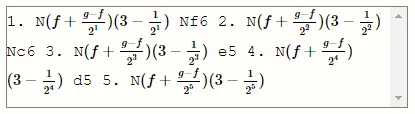
So I realised a further problem while trying to implement the PGN - or rather just think about it - is that when you play a knight move it moves horizontally between columns which would mean needing to talk about fractional columns which... didn't make sense. But then I've been thinking maybe by using the algebraic look of the chess notation, we could do something like
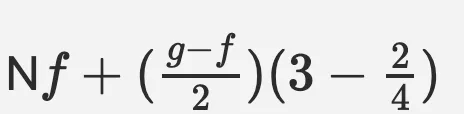
Which is kind weird to look at, but would specify the first move of Nf3 as played by Zeno? That is, it's a move from f + the difference between g and f (one column) over two (to get halfway between f and g) and then the vertical component is what you'd expect - the destination minus half the distance remaining. Expressed as a formula there's something a little bit appealing about it I think? And it makes sense that this is roughly how it would look?
Anyway I think this at least allows me to push forward with it.
The checkmating of Zeno
The other problem with Zeno is that you can be kind of both in and not in checkmate. As in, you're not in checkmate according to the game because you could move the king or shield it, but because of the Zeno-ing of your initial move, in fact you can't defend yourself because that move isn't done, and so you are in a kind of checkmate.
So how should black respond? I can either call the game off at that point, notating it as checkmate by throwing the hash onto it officially. It's checkmate because the king is in check, cannot move, and cannot be shielded.
OR I allow black to capture the king. As I think about it, I'd rather avoid this avenue? It seems wrong to show the king being captured.
Danaids and black in checkmate
Though this also speaks to Danaids, in which I don't really want the Danaid to checkmate black (doesn't make sense to win), and so one funny response is you get checkmate, capture the king, and on you go? But then that's the same weirdness.
Perhaps when you checkmate the king is just moves to another square elsewhere (not in check obviously), similarly sliding through your fingers like water. I think I could live with that...
? Finally managed to tweak the algorithm to acknowledge that stalemate has value for white so that black avoids it
? Decided to construct it myself for flexibility rather than using chess.js's version (you can get the individual moves out anyway, so no big deal)
? Went with an arrow for the notation to indicate what happened to the captured piece - think it's clear enough.
? Notably any move that involves horizontal movement (e.g. the knights) is going to be difficult to notate in the PGN because how to you notate an interim position between, say, the b column and the c column??? Like 0.5b0.5c? Gross. c/b? What???
? Further to that ol' chestnut there's an issue around handling checkmate here, since black could technically put the king in check and the king wouldn't be able to move (because their first piece is still moving), which would be like checkmate... but it's also not checkmate. What does one do in that scenario? Capture the king? Perhaps so... it's at least decisive?
? Including the king simply teleporting out of checkmate. Ha ha. I should test it though.
? Set up a checkmate position and then observed it not working in a couple of different ways. Fixed it.
? Thank you MathJax
? It looks pretty cool. Satisfying in a similar way to UI edition's Zeno thing. This one especially funny in part because of the "algebraic" look of PGN notation in the first place. Har har.
? So now it's properly endless. Do I need some kind of indicator of what's happening? Other than the checkmate notated and "Archimedes wins"?
? I think it's probably fine.
? Looking online, writing out games in a single string without linebreaks is actually more common and it suits my needs here in terms of preserving space on the page, so I will surely take it. Should make it plausible that the game fits on mobile screens properly important.
? Added the logo. It feels awkward, but I do want to "sign" the game somehow and this seems to be the way?
? Initially added a note saying "stalemate", but then thought it would be funnier for it still just to say "Zeus wins", like it's not fair but what are you gonna do?
? This made me laugh, which is nice
? This is kind of in reaction to the idea that people might not be super familiar with the myths in the first place and then chess makes them even more insanely abstract.
? In doing this I've started wondering about my representation of Prometheus. It's good at getting that "chained down" idea and struggling, but of course that struggling bit especially isn't a real part of the myth. Maybe I shouldn't actually allow white to move? Oooooh, maybe you try to move, but the piece just animates partway and back, like it's struggled but failed? And meanwhile black makes it's moves and eventually checkmates you YES.
? This included reworking how the king is off the board in Tantalus, and it now kind of comically hovers over the header text which I like. I also like that at the code level its position is defined as the square e8 minus one tile size on y, so it's sort of both "on the board" and not at the same time, which is probably a delicious irony or something. Yo ho ho.
? Now when you move he shakes in place but cannot move, and the PGN is recorded as Ke1 over and over again. Teehee. You get checkmated as soon as you're in check because you can't move out of it. Et voilà, a much better concept, and distinguishes it better from the experience of Zeno.
? It's not playing chess in the immediate sense anymore but it's waaaay more accurate to the myth - it actually looks nicely like it (and is actually quite adequately distinct from Sisyphus I think?). Further, setting up the board is definitely part of the larger conception of playing chess, so I think it's actually something positive to have this aspect of the game used to represent the myth. Further the whole concept of board setup is represented within chessboard.js so it's even valid at the tech level (though in this instance I actually rolled my own piece placement since chessboard.js's version wasn't really working out.)
? But you still can't get the board set up so HA HA
? This is feeling pretty solid
? To give that sense of the branch receding from Tantalus' grasp. It only happens once rather than repeatedly, but I think the idea that each game represents a reach for the desired object (the king) which immediately moves out of reach makes sense. White's first move is the beginning of reaching for the king, after which every move is futile because it moves away from you. You only get to try again after "giving up" or being defeated.
"Finished"
At this point I think the game is basically completed with maybe just some styling issues left to consider (and also to consider whether I want to consider stupid stuff like people resizing the page while playing which... nah... and people going into landscape while playing which... nah...)
I really haven't done a great job of keeping this process journal updated while making the game, in part because I feel like the design process has kind of rushed along and I had insights into what to do while writing commit messages or even writing out to-dos. The point where there hasn't been the same need to sit back and think quite so philosophically about how the game should feel.
As such, let me at least review a few key decisions that got made.
Displaying the number of games played
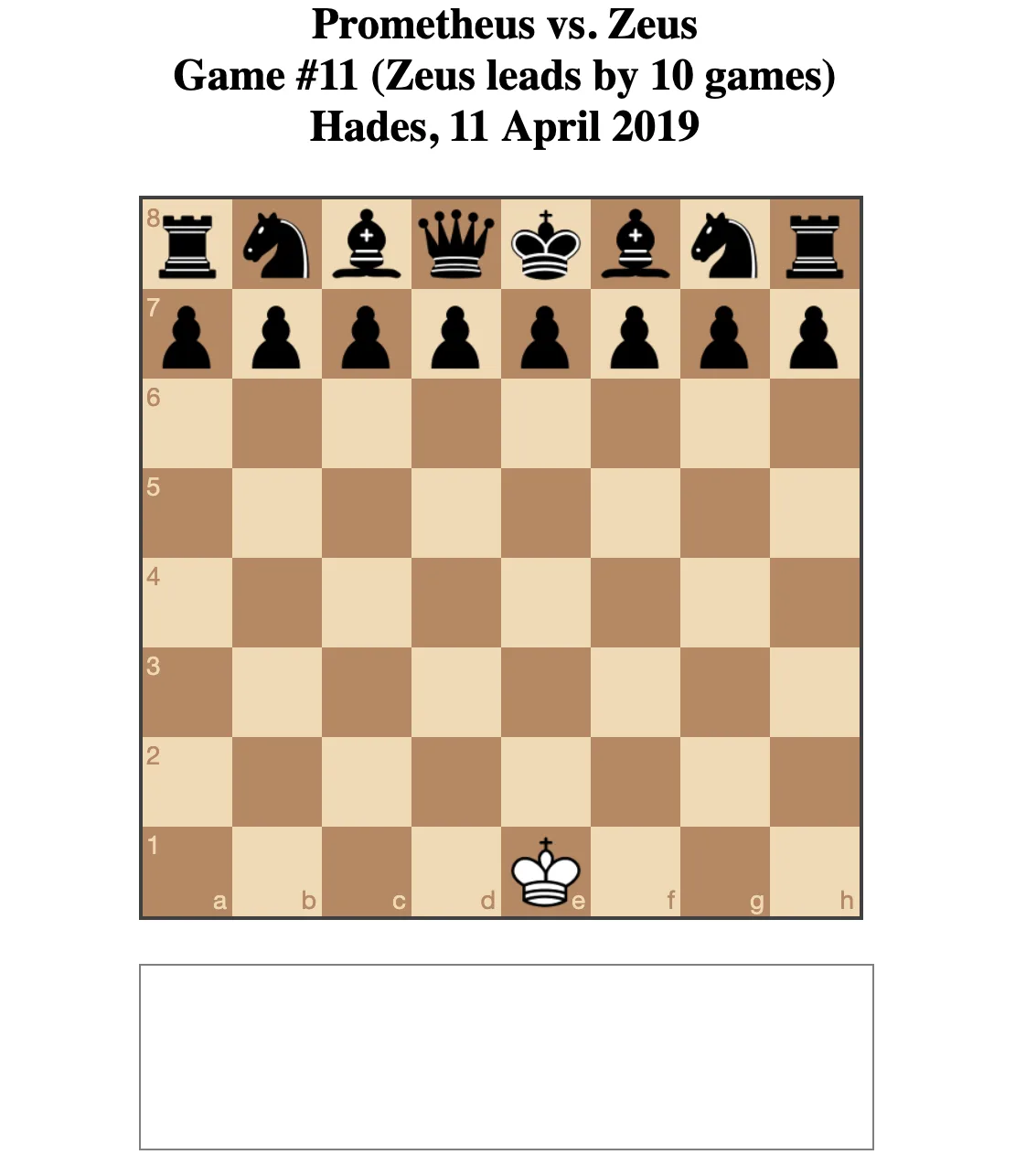
I became a bit dissatisfied with the game headers at some point because they weren't really reflective of the idea of ongoing punishment in the versions where multiple games would be played (e.g. white getting checkmated and the game restarting). So I wanted to include some indication of the history of play. Took a while to feel like I had the right idea, but I do like the mean emphasis on how many games Zeus is winning by in each case (or Archimedes for Zeno), it's so pointed and depressing. I also made Zeus win in the case of stalemate which amuses me too. Basically if the game ends, white loses, because they can't ever checkmate black (it's impossible in all forms especially now that Danaids is different).
Danaids overhaul
After sending the game out to testers (though I only really heard back from Jim), I had my suspicions that Danaids was unclear confirmed and ended up feeling like I needed to rework it. Originally the idea was that every captured black piece would "slip through your fingers like water" and go back onto the board. I think the metaphor is pretty sound, but when you're playing it just feels like a comically unfair game of chess, which is good but not great. So I went back into it trying to think about water and went with the idea of the white pieces being the water, so when you start they all pour off the board and in fact the "gameplay" is you trying to get your pieces set up properly while they continuously pour away.

I like this for a lot of reasons
- It's visually interesting in a different way to the other games (each one has its own kind of visual/animated signature which adds to the feeling of variety)
- It genuinely captures the idea of water pouring out of a container and so strongly evokes the original myth in a clear way, rather than in a metaphorical way (I mean, it's still a metaphor, but a much more direct implementation of the entailments?)
- It allows playing with another part of chess that I hadn't been thinking about, which is setup. This speaks the broader question of what it means to play chess - is setting the board up part of the game? I think it's possible to answer that with a yes, or at the very least to say that the larger social practice of chess includes that
- It engages with that part of chess specifically as represented in digital chessboards - chessboard.js even has the specific ability to display "spare pieces" which you can drag into play to set up scenarios. In the end I couldn't use it because I needed a lot more control over how the pieces behaved, but it's nice to feel like there's a hook at the technical level
Prometheus Bound
I originally implemented Prometheus to have a lone king that would be able to move around, opposed by the entire black army. One problem I ran into was stalemate, so I try to make the black AI allergic to stalemate, which largely work (though this is kind of superceded by stalemate being a black victory).
I'd visualised the white moves as "struggles", but when you play it, it looks like too much freedom and doesn't convey the idea of being bound properly. So instead I went with a version where every white move is just the king struggling in his bounds and staying on the same square, completely with PGN reflecting it.
I should also mention that I had a conversation with students about this one (in the prior version where the white king could move) and they said a couple of interesting things about the specific metaphor of the eagle, suggesting that maybe it should be queens or bishops "swooping" in at the king to attack it in order to preserve that specific idea. I like that kind of thinking, and it reflects a larger design question about how specifically you want to represent the nature of myth and the whole distinction between "in spirit" and more literally interpretations. Ultimately I guess a satisfying design is going to walk the line with it, and the "satisfying" bit will just need to be the satisfaction of the designer?
Checkmates
As in the previous post, I spent time fretting about checkmate in both directions. Notably you don't want white to checkmate black (it's meant to be a more futile experience than that!)
- Sisyphus never begins so no problem there
- Prometheus can't move so that similarly no problem
- Tantalus has no black king on the board to it can't be checkmated
- Zeno effectively "can't move" so again no problem
- Danaids also never begins now (it used to be a concern as I wondered whether it might have been possible to checkmate black with amazing play, but even then I ended up implementing the idea that the black king would just teleport out of check)
Similarly, I need black to be able to checkmate white through standard play (since the AI needs to accomplish it!)
- Sisyphus never begins, so no problem
- Danaids never begins, so no problem
- Prometheus can't move so I made it that any check is effectively checkmate
- Zeno is similar to the above, any check it effectively checkmate
- Tantalus plays normally, so black can checkmate white for sure - the game could also end in stalemate, in which case black also wins
So this key question of how to handle game-ending stuff is pretty well handle I guess?
And now?
Well I think it's kind of done, eh. There's definitely more I could do to make it slicker, but like everything I do it's pretty much conceptual with aesthetics being advanced far enough to support the idea and no further? In which case press kit etc. and release... Friday? Next week Wednesday? Tuesday? Bleagh?
Actually just quietly went and tweaked the CSS a tiny bit and it looks nicer. And then fixed underline color on iOS (needed webkit version). And then fixed weird scrolling issue on iOS (wrapper height set to 100% and overflow hidden). And then ran into stuff with the pieces falling in Danaids causing ability to scroll. And then fighting against this. And then giving up. And this is why we despite mobile versions of our non-pure-canvas games, kids. Sheesh.
Feeling peckish, winding up
Okay now I think we're basically done at this point.
Feeling peckish
After getting feedback from Jonathan about Prometheus I changed it so that now the attacking piece "pecks" the king until it dies (from lack of liver behind the scenes). Ten pecks and you're out. On the last peck the piece captures the king to indicate finality before the game resets.
This is nice for various reasons, most obviously that it's just satisfying visually and sonically to see it happening, it's nice and active, but also
- It functions as a call-across to Rogess (which has the same idea of a "peck" style attack)
- It calls back to the original punishment games by more literally showing the idea of pecking (even at the expense of it being less chess-like I think this is nice, and it's good to get a bit surreal here and there)
- It relates to a conversation with my CART263 students about the idea of being attacked by "birdlike" pieces. Funnily enough we decided that the bishop is the most birdlike and it happens to turn out that the AI actually targets and pecks the king with a bishop - through no control of my own.
So that works out!
Winding up
I think the game is about as done as I can make it, so it remains to send it out to press and pick a release date. I was thinking of Tuesday next week, so perhaps I'll do that.
? Quotes are up for longer to make them more readable (calculated based on quote length to avoid discrepencies)
? Instructions for Danaids to make it clear you're supposed to set up the board
? Prometheus now gets "pecked to death" by the checking piece (I guess it's always the bishop) which is pretty comical and is a nice callback to the other games.
? Disabled input for white in between moves as it seemed capable of leading to weird non-moves? (Think this fixes a bug Jonathan reported)
? Sound effects improved for all versions (Danaids pieces make a sound when falling, Tantalus king makes a sound when stepping off, Zeno piece makes a sound per half-move, Prometheus king makes a sound when struggling, and so on)
Closing Statement
Let's Play: Ancient Greek Punishment: Chess Edition is the eighth addition to a series of games based on the mythological punishments of Sisypuhs, Prometheus, Tantalus, the Danaids, and (less canonically) Zeno of Elea. In Chess Edition I tried to tell these stories of punishment through the language of chess (and perhaps specifically computer chess).
As the series accumulates, it continues to serve as a way to think through specifics of design: with the core concepts (the myths) set in place, the decisions to be made can be distilled down to the design implications of a particular conceptual take ("what if you were the boulder resisting Sisyphus?") or a specific form (how do I represent these ideas through the language of chess?). Chess is particularly satisfying in that it represents an almost platonic understanding of a "game", so translating the myths to chess feels like an ultimate game-designerly activity.
Beyond this kind of highfalutin design stuff, the project also interests me significantly at the level of the underlying technology. I'm using chess.js, a JavaScript chess library, and chessboard.js, a JavaScript chessboard, and both naturally have a particular "grain" to how they do their jobs, making some things easier or more "obvious" than others. I find it nice to think about chess.js especially as manifestation of "pure chess" in code form, giving the abstract existence of chess a tangible agency in the project.
In the following, I want to focus in on each of the five sub-games in Chess Edition in order to reflect on specific elements of the design trajectories followed to reach their final form. In keeping with the Games as Research project, a lot of what I'm interested in here is revealing the inner workings of design and development, the mistakes made, the decisions reconsidered, and so on.
Sisyphus undone
Sisyphus was both the first game I envisaged in chess-form and the easiest to implement. From the beginning the idea was to allow the player to make an opening move (say "e4"), only to have the piece fall back to its original position, just as the boulder rolls back down the hill. It feels like a particularly pure representation of the myth and is aided in this computer-chess context by the traditional representation of white at the bottom of a vertical board, lending a sense of "falling back down" to the piece that wouldn't be there in other orientations.
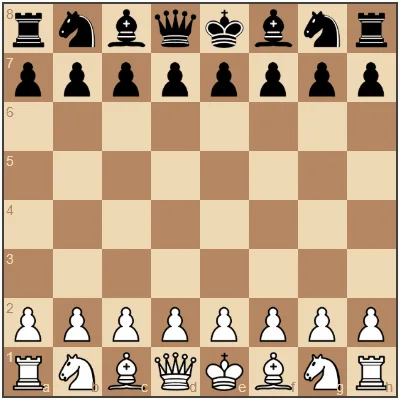
This variation is important to me in how precisely the myth is mirrored in the underlying code using the two chess libraries. Using chess.js the code calls a move function to move the piece, then almost immediately calls an undo function to put it back where it was. Thus doing and undoing is literally true at the level of code. chessboard.js is similarly cooperative in that it animates the movement of the piece and its undone movement faithfully without any intervention from me (it doesn't care about the frustrating nature of the undone move, just like the gods).


So, in the end there were few decisions or changes to make here: chess, code, and punishment were in harmony and it was only a matter of "discovering" this through the process of making.
The apple king
In the Tantalus game I knew early on that I wanted to have the black king be off the board and thus unattainable - the myth's punishment is all about an unattainable object of desire (an apple/piece of fruit in the original) and it makes sense to me that the object of "desire" in chess is the opponent's king. However, when I tried to simply begin a chess game without the black king on the board it turned out to break chess.js, which isn't able to process legal moves in this scenario (0a08d10). This led to a moment of truth where I had to decide whether to do battle with the underlying chess code itself, or try another approach, and initially I went the "easy" way by attempting a version where there were simply no black pieces on the board at all (avoiding the need to calculate legal moves for black, 4452f40). As I noted in my process journal, though, this rang false with the myth: "philosophically this one would be suggesting that part of the point of chess is the destruction of the opposing army, which is less pure than solely thinking in terms of capturing the king."
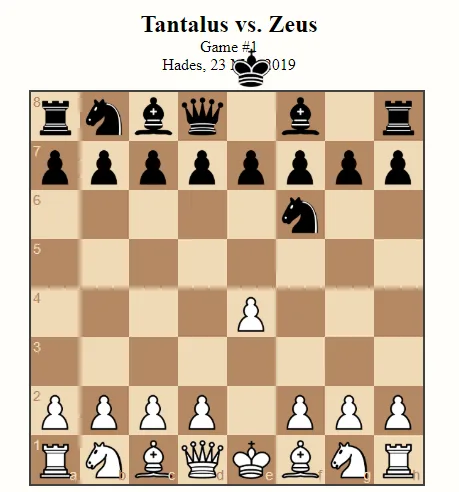
So it became clear I needed to solve the issues around having just the black king off the board and I went ahead to edit chess.js to allow for this, eventually succeeding: Tantalus looks so much better with just the king gone. The joke is much stronger, and there's something terrible and funny about playing chess in this context, knowing you cannot possibly win and can at best end up capturing every black piece, only to have the king perpetually out of reach (8168f81). Having solved the core technical problem, it remained to tune the comedy of the kingless board by having the black king "step off" after white's first move (eda45d2), though on reflection I clearly missed the opportunity to also register this stepping off as officially black's "opening" in the game, complete with notation (1. e4 Ke9 perhaps, or even 1. e4 K??).
What's the right game-feel for having your liver pecked out?
The key design question for the Prometheus version was about "feel": in the original game, it was the sense of helplessness and passivity for the player that I found especially resonant and interesting as an experience, and I felt I needed to recreate that in the metaphorical chess version. I began by reducing white's pieces down to just the king, to create that idea of solitary misery. The king can move around the board before eventually being checkmated by black due to its weakness, though as I noted in the commit message I was very concerned by the fact that black would often stalemate white, which didn't feel appropriately punitive (ec8423d). The core idea was that white needed to move around on the board to recreate the basic sense of "struggling" that is present in the myth and the original game.
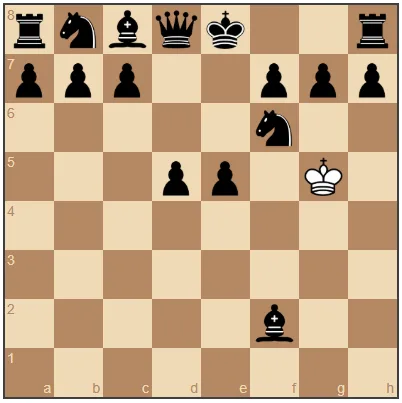
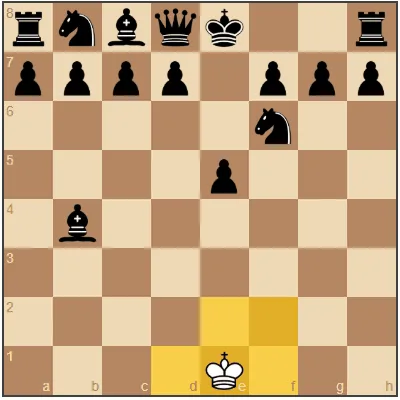
Eventually, however, even being able to move on the board felt like a degree of freedom too far, and I chose to step away from official chess rules once more in order to have a king that simply could not move. That is, you could select a legal square adjacent to the king, but on selecting it the king would only jiggle in place as if struggling against invisible chains. Black would then complete its own move and the cycle would continue. In this version I further modified the rules to consider any check of the white king as checkmate given that the king could not move or protect itself (2110d10).
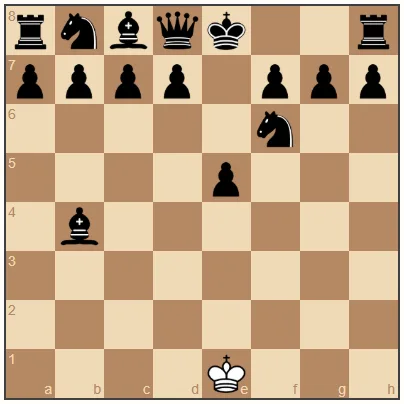
I was completely happy with this version, but my colleague Jonathan Lessard expressed after playtesting that he missed the visceral idea of pecking and suggested adopting a technique we'd been using for a version of our game Chogue (subsequently released as Rogess) in which pieces effectively "peck" each other, swooping in to do damage and then returning to their original position. Interestingly, this echoed suggestions I'd heard from the students in my programming class that "swooping" pieces might better evoke the sense of an eagle. It's important to listen to strong feedback, and I implemented this more overt pecking version right away (fe2c3d07).
Chess as water
The Danaids level of the game is a good example of needing to totally rethink a design based on feedback, leading to what I think is a far superior and more interesting interpretation of the myth. The core of the myth revolves around dealing with water that is always flowing away before you can finish the job, so the initial idea was that whenever white captured a black piece, the piece would simply respawn on the board, thus "slipping through white's grasp like water" (f68112a). Even in my earliest thinking about this in the process journal, it was clear that I had serious doubts: "There's a slight lack of clarity in terms of how to represent this happening... How clear will it be to a player what is happening?" I soothed myself somewhat through the amusement of also making the king able to "teleport" out of checkmate to avoid white winning (cc1baea), but in the end it was obvious during testing that this was a deeply opaque representation of the myth and I needed to rethink.
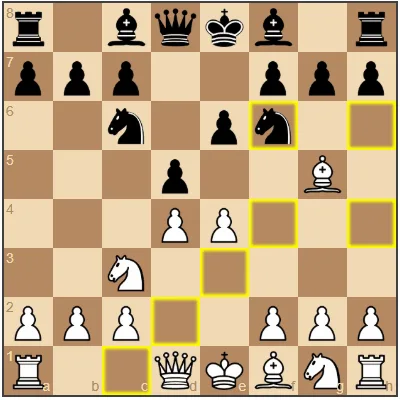
After some thought it seemed obvious that the right way to go about things was for pieces to fall off the board, dripping like water. Initially, I thought this would happen at the beginning: white's pieces would drip from the board and after that they would be incapable of playing. However, that approach negated the infinite, cyclical nature of the punishment myths. Instead, I went with a part of "playing chess" that might or might not be considered actually part of the game: setting up the board (c356883). In the final version your pieces drip off the board, but you are able to then attempt to set the board up again in order to be able to play (only to have those pieces also drip off, etc., creating the desired infinite loop). As I note in the process journal, this is satisfying on multiple fronts: it gives Danaids its own unique "visual signature", distinguishing it from the other versions; it is pleasingly literal in its representation of the flow of "water"; it incorporates a wider understanding of what it means to play chess by including setup; and it couples tightly with how digital chessboards often function, with a row of "spare" pieces along the bottom that you use to create board positions to investigate (though in the end I implemented my own version of this rather than using chessboard.js's built-in support).
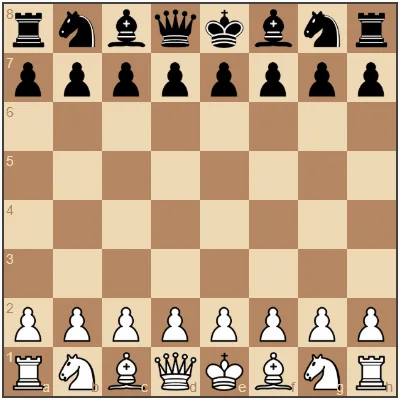
Danaids is thus a great illustration of how important it is to pursue the "right" version of your idea, rather than settling for an idea that works but is perhaps not completely true to the spirit of your work. If I'd settled for the "respawning" pieces, it would have been fine, but I would have missed a much more integrated and satisfying representation of the underlying myth. Note how much this was helped along both by acknowledging my own doubts in the documentation, having those doubts confirmed through testing, and then being willing to do the extra work to go back to the drawing board.
Algebraic paradox notation
Zeno was straightforward to design in terms of the chessboard itself - as with past iterations of the punishment series, it would entail that in making a "move" in the chess game the piece would first need to move halfway to the destination square, then halfway again, and so on - the punishment here being that each "half-move" white makes is responded to by a normal move from black (b20bfa0). (As a side note, it was this Zeno version that forced me to using click-based play rather than dragging, since this would be the only way to enforce my own rules on moving through space (df0bc89).)
On getting the movement working, though, I realised that the true design problem was the notation: chess games are traditionally documented in PGN notation, but the Zeno version contained impossible moves that don't fit within this, with moves that take half a square for instance. This can be solved for the vertical component (along files) because those are numbered and those numbers can be fractional (e.g. if white plays e4 they actually see 1. e3 ... 2. e3.5 ... 3. e3.75 and so on). For the ranks, which are represented by letters, it's not as simple (7c18f8d). Fortunately, I was able to solve the problem by noting that chess notation is often referred to as algebraic notation, pointing to the idea that it's a form of algebra, and that one can of course perform the kinds of mathematical operations in algebra that you would need. Even more satisfyingly, I further realized that one retort to Zeno's paradox is Archimedes's suggestion that it is solved using geometric series. This gave me a specific mathematical format with which to express each individual move:
In the end, I think Zeno is especially fun because Zeno's punishment is emphasised through the disparity between his eternal half-moves and black's regular moves, suggesting that Zeno is wrong, but must still play by his own rules. To sharpen the blow, Zeno's listed opponent is Archimedes and the representation of Zeno's moves is in the form of geometric series, but without the vital summing to infinity that would solve the paradox! Take that Zeno!
Checkmate! Play again!
That brings us to the end of this discussion, and I hope I've illustrated some of the complexity and murkiness that goes on behind the scenes of even a series of tiny little games with big design dreams. I hope, too, that this goes some way toward showing the value of an intensive documentation process during design and development. Without the fairly comprehensive work I did to document this game, there's no way I'd have been able to unpack all this, nor support it with specific evidence from the development process itself.
Let's Play: Ancient Greek Punishment: Chess Edition was a very satisfying project, with many neat design moments, insightful testers, and generative frustrations. The "conversation" with chess.js and chessboard.js remains a highlight, with interesting give and take between the "correct" representations of chess and my diversions from them. Chess is surprisingly "flexible" in terms of its expressiveness, and that in combination with the highly metaphorical nature of the myths themselves has led to what I think is a coherent hybrid. Ultimately, I think game design and development is a way of thinking about particular ideas and then somehow making that thought process available to players of the game itself, and I feel like is a good move in that direction. Thanks for checking this out.