
Design as Iterative Translation Between Languages of Meaning and Grammars of Systems
By Mohamed Gharbia
Re: Let's Play: Ancient Greek Punishment: Chess EditionSeptember 24, 2026
Let's Play: Ancient Greek Punishment: Chess Edition was released by Pippin Barr in 2019, the eighth entry in a series that translates Greek myths of eternal punishment as different game forms. This edition takes five of them, Sisyphus, Prometheus, Tantalus, the Danaids and Zeno (not particularly a punishment but a paradox), and expresses each as a variant of chess scenario. The premise is stated in the repository's README: "chess already feels like a punishment to plenty of people, so what if it were one."1 All five variants run on a single engine assembled from two JavaScript libraries, chess.js for rules and move generation and chessboard.js for display.
The archive contains a process journal with dated and timestamped entries running from 16 March to 17 April 2019, a to-do list whose completed items are struck through and annotated in capitals,2 a research questions document from 15 April, a related work file, a closing statement written between 21 and 24 May, and a commit history opening on 3 April 2019. The last change to the game itself lands on 8 August 2019 (as of the date of completing this analysis cycle, the current last game change commit dates 23 March, 2026). Read across these materials, Barr investigates a consistent set of objects: the narrative logic of the myths, the user interface as an expressive surface, aesthetic representation, the constraints of the software he builds on, and his own tone in reflection and documentation.
Barr writes that he is translating Ancient Greek punishments into chess, places the project within a translation practice he had been pursuing for several years, and calls chess "a great material to think through expressively."3 I took that term seriously and asked what happens when translation is treated as a method instead of a figure of speech.
Design as a Non-Linear Process in Pursuit of Legibility
The coding ran in three passes, documented on a shared board where each segment carries an identifier and the date and time of the material it came from.4 It follows a grounded theory framework, where qualitative approaches derive design knowledge triangulated across commit messages, playable builds, code and journal entries.5 Coding here is constructivist, with codes refined across successive rounds instead of applied from a fixed codebook, which is also how the group describes its own approach to the analytical phase.6 7 The coded corpus is the process journal, the to-do list, the research questions document, the images embedded in the journal, and the commit messages up to 21 May 2019. The first pass open coded the textual materials, labelling segments for what they were doing instead of what they were about. The second pass added the commit history and introduced axial coding. The third pass set the shipped build and the closing statement against the coded corpus, level by level, which is how the small number of post-May commits cited below were reached. The closing statement is used here as a document tested against the running record and is not itself coded material.
Five axial categories were extrapolated, given here in the wording used on the board: translating forms and balancing meaning; questioning the material as a form of materializing the question; system-designer conversation through constraints; designing in and as loops of futility; humour as glue to process.
Read as a sequence, these categories describe a process that does not run in one direction. Conceptual translation proposes a correspondence. Material questioning tests it against the target. System negotiation settles what the target will concede. Iterative breakdown returns the proposition to an earlier state when the settlement fails. The reflective tone in which the designer records all of this is itself a stage. The process moves through cycles of translation, constraint, failure and reinterpretation until a stable expression is reached.
Four questions organised the framework of this analysis: What elements of linguistic translation can be borrowed to analyse the affordances and constraints of design processes? What are the effects of the designer's positionality in processing materials as a language of communication? What is eloquence in design understood as translation? Where do the power dynamics of human and machine translation sit in a game design context?
Two points interested me, maybe worth documenting. In the entry of 15 April, Barr notes that the journal went underused during the busiest stretch of development, because insights were arriving "while writing commit messages or even writing out to-dos" instead of during set-aside reflection.8 Being immersed in process brought about simultaneous reflection that would otherwise be lost. The second point concerns the earliest entry, dated 16 March, which predates the commencement of the de facto "material translation" process by more than two weeks and lists four of the five mechanics in a single line: "piece falls back at opening; opposing king is off the board; piece moves halfway over and over; you can't move and king is captured over and over: danaids?"8 Five punishments reworded as five mechanical propositions with no target in sight, as if conducting a quick intralingual translation from a source material to a target material within the confines of the same spoken/written language.9 The repository does not document the details of this cycle. Two notebook photographs posted on 2 April are its only surviving trace.
Stabilizing Conceptual Subject, Material Object and System Grammar as Requisite to Legible Translation
The design process repeatedly takes the form of moving conceptual material into the formal grammar of a game system. Barr treats the myths as structures to be mapped onto programmed chess mechanics, and the mapping is visible in the journal entries that formulate each punishment alongside its mechanical equivalent. Roman Jakobson, in his essay On Linguistic Aspects of Translation defined 3 categories of translation, the third being intersemiotic translation, where verbal signs are interpreted through a nonverbal sign system.9 Here the target is layered, since the myth passes through chess rules, then through a programming language, then through a compiled interface, and each layer has a grammar of its own.
The target also arrives with a fiction problem of its own. Jesper Juul classifies chess as an incoherent world game, one that projects a world while making a complete fictional world very hard to imagine, because what happens across a chess game does not read as description of events in any world.10 On this reading the project is fitting five coherent myths onto a system whose own fiction players have long since learned to disregard, which may be a different problem from adding fiction to an abstract game. It is difficult to imbue chess with inherent theatrical drama that is not centered around players besting each other in strategy and probability.
Each myth reaches the journal already paired with a mechanical equivalent: a move that reverts (Seg31), a king off the board (Seg34), a king stripped of movement (Seg66), a board that empties and must be refilled (Seg63–65), and a piece that halves the distance it has left.
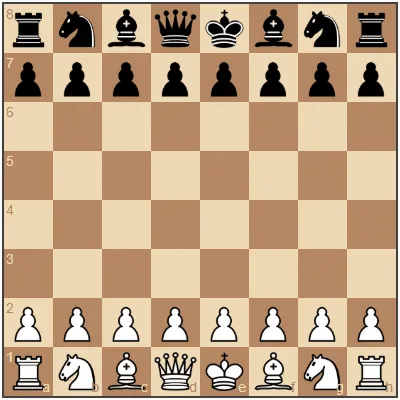
The chess rule system can be read as a grammar determining which propositions are expressible directly and which have to be adapted. Its refusals are specific and dated. chess.js cannot calculate legal moves on a board without a king, which forces a workaround for Tantalus (To-Do Seg17; 0a08d10, 4 April). chessboard.js can animate a piece to a square and not to a point between squares (at least not in a forward manner), and chess.js acts on any piece present in the board state, so Zeno's animation is written outside the display library and the piece is removed from the logical board (To-Do Seg26).
Two translation-studies accounts offer vocabulary for the consequence, and both are flexibly adapted here, since each was written about a translator working on a text and the pressures in this repository are enforced by a runtime. Antoine Berman's deforming tendencies are the systematic pressures a target exerts on a source until the source is reshaped to fit.11 George Steiner's hermeneutic motion describes translation as a movement of trust, aggression, incorporation and restitution.12 For example, in the translation of Tantalus, Barr trusts that chess can carry the myth, breaks into the library by editing chess.js on 5 April, incorporates the result as a working level, and on 13 April forsakes that modification. Steiner's restitution is concerned with the source's authenticity. By translating the text faithfully and vividly, the translator elevates, enhances, and gives life back to the original work, paying back the "debt" incurred by taking it from its native culture. Here it is made to the target, since what is restored is the unmodified library, and the myth of an unreachable object leaves as a display of pieces arrangement determined by what a chess engine requires to be present on a board. This has resulted in a pivotal piece being visually present but mechanically impossible to participate in the game, hence, unreachable BUT reasonable within the grammar of chess.js. An argument for a form of compromise to respect the source and target's structure and legibility.
The Designer as Simultaneous Translator and Reader
Barr occupies two positions at once, interpreter of the conceptual material and participant inside the system being built. Reflection and implementation run together. The insights recorded as arriving during coding instead of during reflection are also design decisions being made there (Process Journal Seg60–61).
This doubling shapes how decisions are justified. They are frequently framed as personal assessments of conceptual fit. The Prometheus redesign of 12 April removes the king's movement because the moving king "looks like too much freedom and doesn't convey the idea of being bound properly" (2110d10).8 Alternative implementations remained available. The criterion applied is Barr's perception of coherence.
Prior familiarity does similar work. Barr had used chess before, in It is as if you were playing chess from 2016 -which simulated the interactions, eye motion, and even a sarcastic simulation of the performance of "thoughts" during gameplay- and the related work file lists it alongside the seven earlier editions of Ancient Greek Punishments the series.13 Early repository entries treat chess as an expressive material and not only as a rule set (Research Questions Seg7), which is what allows board setup, piece movement and notation to be read as available resources. A respawning piece read as water and an immobile king read as bound.
Both of those readings were revised on outside response, and the archive names four sources (including an entire class Barr taught). The Prometheus pecking mechanic of 17 April arrives after feedback from Barr's colleague that converged with a suggestion that Barr's students had already made, that swooping pieces might better evoke an eagle (fe2c3d0).8
Eloquence as Maximal Alignment Between Mechanic, System Behaviour and Concept
Within the coded data, moments Barr treats as successful are marked by the clarity with which a mechanic communicates its conceptual reference and not by technical completion. These can be described as instances of eloquence. Barr describes the user interface in another project as "one of the most eloquent yet shy materials of game design."14 His sense is a property of a material. The sense used here is a property of a relation, which can fail while the material remains as expressive as ever.
Eloquence holds when three elements consistently align:
- the conceptual reference drawn from the source material
- the behaviour of the system implementing the mechanic
- the player's observable experience of the mechanic
All three are present in every level regardless of quality, and what changes is whether they point the same way. Sisyphus -seemingly- aligns them most firmly and closes in a day (Process Journal Seg31). The player moves, the piece slides back, and play never advances. Barr writes that chess, code and punishment "were in harmony and it was only a matter of 'discovering' this through the process of making."15 The code supports the word. The mechanic rests on two adjacent chess.js calls, move and undo, and undo exists so a chess program can take a move back. It was in the library before this project needed it. This form of isomorphic translation is brought about by the source and target materials allowing the designer to find them out given the designer is experienced enough in both. This event interprets (pun intended) the materials themselves as active agencies in the design process, exposing facets of their relational structures and inviting the designer as both translator and reader to identify them.
The Danaids show the relation failing and being rebuilt. The first mechanic, committed 5 April, made a captured piece stand for a drop of water and its return for the vessel refilling (f68112a). Barr had recorded doubts about its legibility twice on 3 April. Writing on 15 April, Barr reports that the a tester found the metaphor "pretty sound" while the mechanic in play "just feels like a comically unfair game of chess, which is good but not great" (Process Journal Seg63).8 The reference, on this evidence, remained readable. What appears to have defeated the translation is the meaning chess supplies on its own; think of one language's expression that works as a literal translation to another language, but also has an embedded cultural meaning that is established in its use, hence distorting the translation. A piece returning to the board is a piece restored to a side, and the feeling attached to that is unfairness in the power dynamic of two equally-powered opponents (no endless water pouring there). Juul's account of the relation would anticipate this kind of defeat. Rules and fiction compete for a player's attention and are complementary without being symmetrical, and game fiction stays ambiguous and optional while the rules stay definite.10 The fiction was available to a player who wanted it, and the rule reading arrived first.
The rebuild lands on 13 April and gives up lateral correspondence (c356883; Images Seg7). What the rebuilt level takes from chess is the labour of setup and the impossibility of finishing it, and Barr lists among his reasons for satisfaction that the level engages a part of chess he had not been thinking about and that digital chessboards already model setup through spare pieces.8 Fidelity does not appear to be the operative criterion for the result, instead, legibility is king. Haroldo de Campos called this rebuilding of a source's effect from whatever the target has to hand transcreation, a term adapted here away from the poetics and the politics it carries in his own writing.16
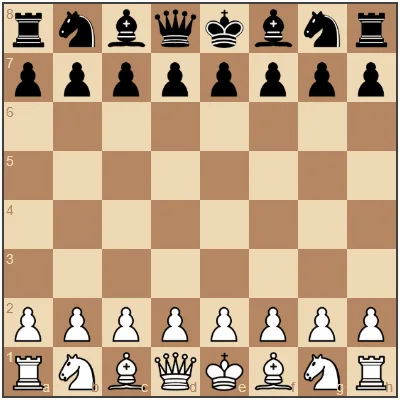
Eloquence invites degrees of alignment, and reading Barr's assessments across the five levels, no threshold appears that a mechanic crosses to become eloquent, it is an elusive and fluid realization through questioning the cycle and the translation questioning back the designer.
Human–Machine Translation as Negotiation with System Constraints
The recurring pattern in the coded data is negotiation between designer intention and the behaviour of the software. Umberto Eco's description of translation as negotiation, "a process by virtue of which, in order to get something, each party renounces something else,"17
The renunciations differ in scope. Barr's first Tantalus cycle removed all of black's pieces so the engine had nothing to calculate (4452f40, 4 April), which he had objected to the previous day on the grounds that "part of the point of chess is the destruction of the opposing army, which is less pure than solely thinking in terms of capturing the king."8 Two concern the rules: in Prometheus and again in Zeno any check is ruled to count as checkmate, stepping away from official chess rules in Barr's own account, and in the first Danaids cycle the black king is allowed to teleport out of check so that white cannot win (cc1baea). On 3 April the drag interaction chessboard.js provides by default is given up for click-based movement, because clicking was the only way to enforce Barr's rules about moving through space (df0bc89). The journal names Zeno's translation as the reason on the same day.8 One level's requirement set the input model for all five. In translation, consistent style is needed to maintain unity for the sake of purpose. Skopos's theory of translation by Hans Vermeer emphasizes the purpose (skopos) behind a translation as the primary factor in determining its methods and strategy 18.
Zeno is where the negotiation appears to reach a limit the system cannot concede. Chess notation assumes discrete positions and the paradox assumes infinite subdivision, so data stopping between files has no name in the system recording it (well, except an error). Writing on 8 April, Barr notes this would mean "needing to talk about fractional columns which... didn't make sense."8 19 Jacques Derrida's reading of the bible's tower of Babel describes perfect translation as simultaneously necessary and impossible. In this case, it is the point where a system is required to articulate what its structure's laws make impossible to voice.20 Barr's response is to take the term algebraic notation literally and write an algebraic expression where a square name belongs, each move a term in the geometric series Archimedes used to dissolve the paradox, with the sum left untaken (Commit Seg50). Zeno's listed opponent in the game is Archimedes.15 The notation was still being corrected on 23 May, after release (a134436).
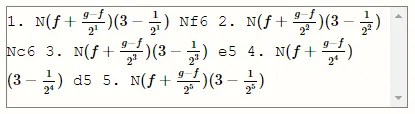
The evidence suggests the system participates in determining outcomes and does not only execute them. Barr describes chess.js as "a manifestation of 'pure chess' in code form, giving the abstract existence of chess a tangible agency in the project," noting that both libraries have "a particular 'grain'" to how they work, and calling the give and take between correct representations of chess and his diversions from them a highlight of the project.15 It is worth noting that he is a designer who considers most of his design work as conversation with stuff, in a frame similar to Donald Schön's account of a reflective conversation with the materials of a situation.14 21 Another case for material's agency is Walter Benjamin's claim in The Task of The Translator that translation never transfers what is essential, and that something in the source resists the transfer, describes the surplus these negotiations leave behind.22 The gloss-over is eventually adapted, since Benjamin locates the resistance in the source and the resistances recorded here are raised by the target. The target is usually easier to adapt in a translation.
The target may also supply "emergent" meaning, and it is here that intended translation and systemic production can be told apart. Chess boards in the used library are conventionally drawn with white at the bottom, so a returning Sisyphus piece travels down the screen, and chessboard.js animates the undoing as faithfully as the doing. In Prometheus the engine sent a bishop at the king with no instruction to do so, and the bishop was the piece the CART263 class had already picked as the most birdlike, which Barr records as happening through no control of his own.8 In the first Danaids the same surplus worked against the level, since the accumulated weight of a piece returning to a side is unfairness. Four of these originate outside the rules engine, in a drawing convention, an animation curve, the cultural weight of the pieces, and the search behaviour of an AI adapted from a tutorial. What answers back might therefore be better described as a stack of materials with different provenances, only some of which are chess.
Iterative Translation
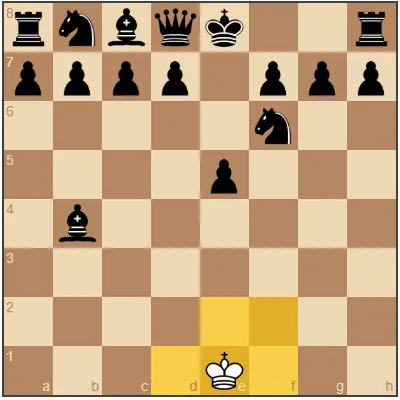
Tantalus shows the cycle completing and then reopening. The kingless board breaks chess.js on 4 April. Barr edits the library itself on 5 April and gets the level working, the corresponding to-do item annotated "I AM A PROGRAMMING GOD." On 6 April the display of the off-board king is fixed "in the hackiest way imaginable," his own quotes around fixed. On 13 April the modified library is abandoned, the black king stays on the board, the game runs on unmodded chess.js, and the king is animated off the board after white's first move. That is the shipped version. Corroboration arrives on 8 August, three months after release, when a bug has pieces vanishing on e8 because of relative and absolute positioning of what the commit message calls the elusive king (ab3d4b5). That is a CSS problem, which is what a display object has.
Peter Naur's account of programming offers one explanation for why the edit did not hold. On the theory building view the primary product of programming is a theory held by the programmers, to which program texts and documentation are secondary, so modifications made without a grasp of the underlying theory decay the program they are applied to.23 chess.js was not Barr's program and its theory was not his. Naur also sets a limitation that may not be crossed; an essential part of any program is bound to the people who hold its theory and cannot be written down, so the archive preserves what was decided and when, while the understanding that made those decisions available stays outside it.
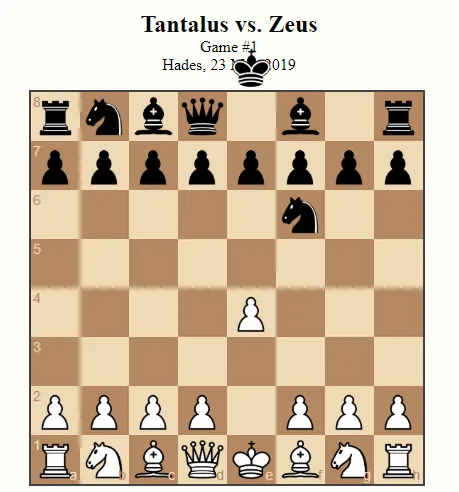
The closing statement, written six weeks later, reports the library edit and its eventual success, links the 5 April commit, and then presents the animation as tuning the comedy of the kingless board.15 Every sentence is true of the moment it cites. The eight days between the two commits are absent. The sequence is legible only because the method commits the reflection and the code to the same repository, and the FDG paper "Documenting Trajectories in Design Space..." anticipates this class of finding when it argues that directions not followed remain accessible points in the design space and are of interest in themselves.24 The authoring group has since argued that MDM archives make it possible to ground claims about design artifacts that no longer exist, and the modified chess.js is such an artifact.25
Barr's own summary concerns expressibility. He writes that he was "really surprised that I haven't run into a scenario where I just cannot express an idea in the new medium," attributing this to shifting "to different levels of abstraction to get around problems of specificity."3 The coded segments bear this out. What a retrospective sentence compresses into a claim about expressibility, the running record keeps as a sequence of dated renunciations distributed unevenly across five myths. Design understood as translation appears iterative in that specific sense, and recursive in a further one: the designer reads the system produced by a decision as new material for the next decision. The proposition is made, the target answers, the proposition is remade, and the record of the exchange is the only place the cost is held.
Footnotes
-
Pippin Barr, "To-Do List," in the same repository (GitHub). ↩
-
Pippin Barr, "Research Questions," in the same repository (GitHub), committed 15 April 2019. ↩ ↩2
-
Coding board (Figma). Segments are arranged by source material and colour-coded by the five axial categories; each carries an identifier and the date and time of the material it came from. Accessed 11 September 2026. ↩
-
Rilla Khaled and Pippin Barr, "Generative Logics and Conceptual Clicks: A Case Study of the Method for Design Materialization," Design Issues 39, no. 1 (2023): 55–69, doi:10.1162/desi_a_00706. ↩
-
Kathy Charmaz, Constructing Grounded Theory: A Practical Guide through Qualitative Analysis (London: SAGE, 2006). Open coding derives from Barney G. Glaser and Anselm L. Strauss, The Discovery of Grounded Theory (Chicago: Aldine, 1967); axial coding from Anselm L. Strauss and Juliet Corbin, Basics of Qualitative Research (Newbury Park: Sage, 1990). ↩
-
Adrian Demleitner, Rilla Khaled, and Courtney Blamey, "Designer as Guest, Collaborating with Materials," in Proceedings of the 21st International Conference on the Foundations of Digital Games (New York: ACM, 2026), doi:10.1145/3815598.3815688. The analysis materials for that study are deposited at codeberg.org/thgie/ostrakinda. The constructivist alignment is stated in the account of MDM's analytical phase; the paper's finding on retroactive sense making in design documentation converges with the Tantalus case discussed below. ↩
-
Pippin Barr, "Process Journal," in lets-play-ancient-greek-punishment-chess-edition (GitHub, 2019). Entries are dated and timestamped; dates are given in the text. Segment identifiers refer to the coding board. ↩ ↩2 ↩3 ↩4 ↩5 ↩6 ↩7 ↩8 ↩9 ↩10
-
Roman Jakobson, "On Linguistic Aspects of Translation," in On Translation, ed. Reuben A. Brower (Cambridge, MA: Harvard University Press, 1959), 232–39, at 233. ↩ ↩2
-
Jesper Juul, Half-Real: Video Games between Real Rules and Fictional Worlds (Cambridge, MA: MIT Press, 2005). Chess as an incoherent world game at 131, rules and fiction as complementary and asymmetrical at 121, game fiction as ambiguous and optional at 162. ↩ ↩2
-
Antoine Berman, "Translation and the Trials of the Foreign" (1985), trans. Lawrence Venuti, in The Translation Studies Reader, ed. Lawrence Venuti (London: Routledge, 2000), 284–97. ↩
-
George Steiner, After Babel: Aspects of Language and Translation (Oxford: Oxford University Press, 1975), the hermeneutic motion in chapter 5. ↩
-
Pippin Barr, "Related Work," in the same repository (GitHub). ↩
-
Pippin Barr, The Stuff Games Are Made Of (Cambridge, MA: MIT Press, 2023), the user interface as an eloquent material at 60, Zeno among the punished at 32. Available open access. ↩ ↩2
-
Pippin Barr, "Closing Statement," in the same repository (GitHub), committed 21–24 May 2019. ↩ ↩2 ↩3 ↩4
-
Haroldo de Campos, "Translation as Creation and Criticism" (1962), in Novas: Selected Writings, ed. Antonio Sergio Bessa and Odile Cisneros (Evanston: Northwestern University Press, 2007), 312–26. ↩
-
Umberto Eco, Mouse or Rat? Translation as Negotiation (London: Weidenfeld and Nicolson, 2003), Introduction. ↩
-
Vermeer, H. J. (1996). A Skopos Theory of Translation (Some Arguments for and against). Heidelberg: TEXTconTEXT-Verlag ↩
-
Barr refers to the lettered dimension as "columns" in the journal and as "files" in the closing statement. The lettered dimension is conventionally the file and the numbered one the rank; the substance of his point is unaffected. ↩
-
Jacques Derrida, "Des Tours de Babel," trans. Joseph F. Graham, in Difference in Translation, ed. Joseph F. Graham (Ithaca: Cornell University Press, 1985), 165–207. ↩
-
Donald A. Schön, The Reflective Practitioner: How Professionals Think in Action (New York: Basic Books, 1983). Barr's gloss is in The Stuff Games Are Made Of at 6. ↩
-
Walter Benjamin, "The Task of the Translator" (1923), trans. Harry Zohn, in Illuminations, ed. Hannah Arendt (New York: Schocken, 1968), 69–82, at 69–72. ↩
-
Peter Naur, "Programming as Theory Building," Microprocessing and Microprogramming 15, no. 5 (1985): 253–61, doi:10.1016/0165-6074(85)90032-8; reprinted in Computing: A Human Activity (New York: ACM Press, 1992). Consulted in the reprint in Alistair Cockburn, Agile Software Development (Boston: Addison-Wesley, 2002), 227–40, primacy of the theory over program text at 231, decay under modification by programmers without the theory at 233–34, and the impossibility of revival from documentation alone at 235. ↩
-
Rilla Khaled, Jonathan Lessard, and Pippin Barr, "Documenting Trajectories in Design Space: A Methodology for Applied Game Design Research," in Proceedings of the 13th International Conference on the Foundations of Digital Games (Malmö: ACM, 2018), 1–10, doi:10.1145/3235765.3235767. Hot and cold analysis in sections 3 and 5.3, directions not followed in section 5.4. The paper does not yet use the name Method for Design Materialization. ↩
-
Rilla Khaled and Marcelo Bethancourt, "Materializing Design Knowledge with the Method for Design Materialization," in Proceedings of the 21st International Conference on the Foundations of Digital Games (New York: ACM, 2026), 1–11, doi:10.1145/3815598.3815635. ↩