
Instauratio Exiguus is an alt-ctrl puzzle that explores repetition and contemplative practice.
It is a minimal, contemplative, alt.ctrl game where players use a hand-made, synth-like controller to find the correct locations for on-screen pixels. Subtle visual and sonic cues help to guide the player. As these pixels are moved to their correct locations, they create unique constellations. The creation of these constellations resolves obfuscated abstract content on the screen, revealing texts from Søren Kierkegaard's essay Repetition. Once the image is fully uncovered, the player is given the opportunity to read the text before the whole image shrinks back down to the single white dot, offering them the opportunity to undergo the activity again. Through this repetitive act of finding, listening, observing, and reflecting, the player is invited into a more contemplative form of play, a play that is guided by them, where there is no discrete ending or win-state.
Timeline
Okay. Wow. So this went really fast. This project started as an experiment to make a simpler version of Lest Ten Horizons Cry for the upcoming LUDODROME event at SAT in Montreal, but also an excuse to see how Cursor could speed up the design process. And it did. It's been a while since I've had this much fun making something. Getting Cursor (and claude underneath the hood) to take care of some of the tedious tasks is great. It ends up feeling more sketching out game ideas. Because it is happening so fast, I feel more open to the actual design-side of the project, similar to when I had RAs working with me on TIKATMOS.
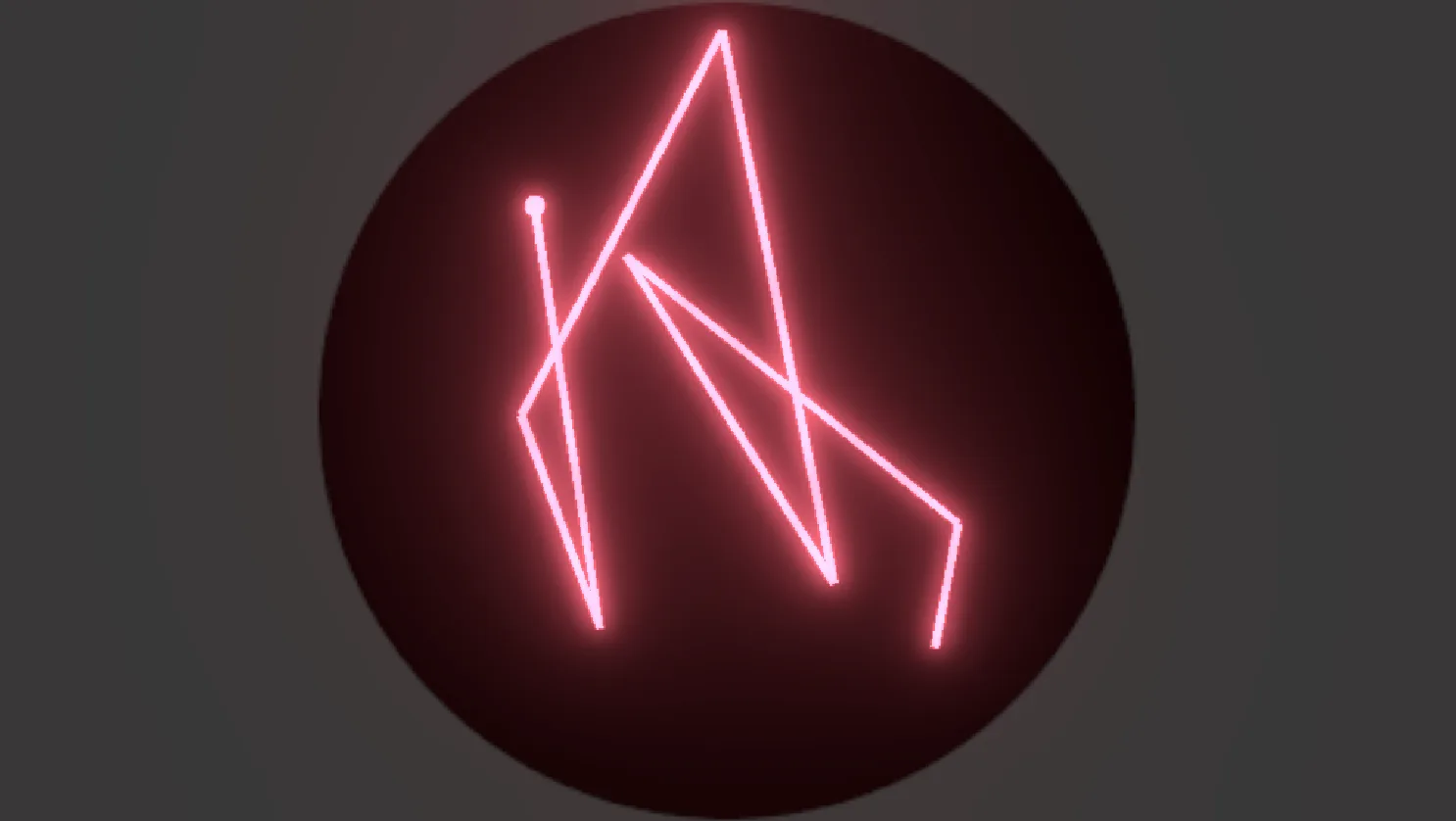
The general idea is simple node-based etch-a-sketch style movement, where you're trying to locate hidden locations and lock them in. Once you do an additional node is created, which is linked by a line to the current node. After you set a certain number of nodes (8 in the current version) the nodes start to return to the center and you start again. You end up forming some sort of organic constallation of nodes, which feels somewhat interesting? Obviously once sound is in here, it will be more compelling, but I like the idea that you are generating (with the system) a piece of music that is unique each time. Currently it is set by the system (you trying to find the nodes) but it could also be user-directed?
Next
- Build out the synth in Max MSP
- Import that into the project via RNBO
- Apply the sounds to the node control. This could be set (i.e first node is alway reverb, etc etc) Or maybe it's randomized each time?
- I like the idea of a directory of these saved sounds. Like you could load up the constellations that someone else has made from a menu on the right? But for now, I'll focus on the audio setup and see where it lands.
Process documentation covers all of this, but the speed of using cursor to help build this means I got caught in a whirlwind of activity. As this continues it may be necessary to take small breaks within a day to talk about what is hapenning since things are hapennign at a great speed than they normally do.
Busy Week!
Well, I haven't done anything on this for a while, but when I picked this back up this week I started in on more visual development, rather than doing any sound-based stuff that I had claimed was next...
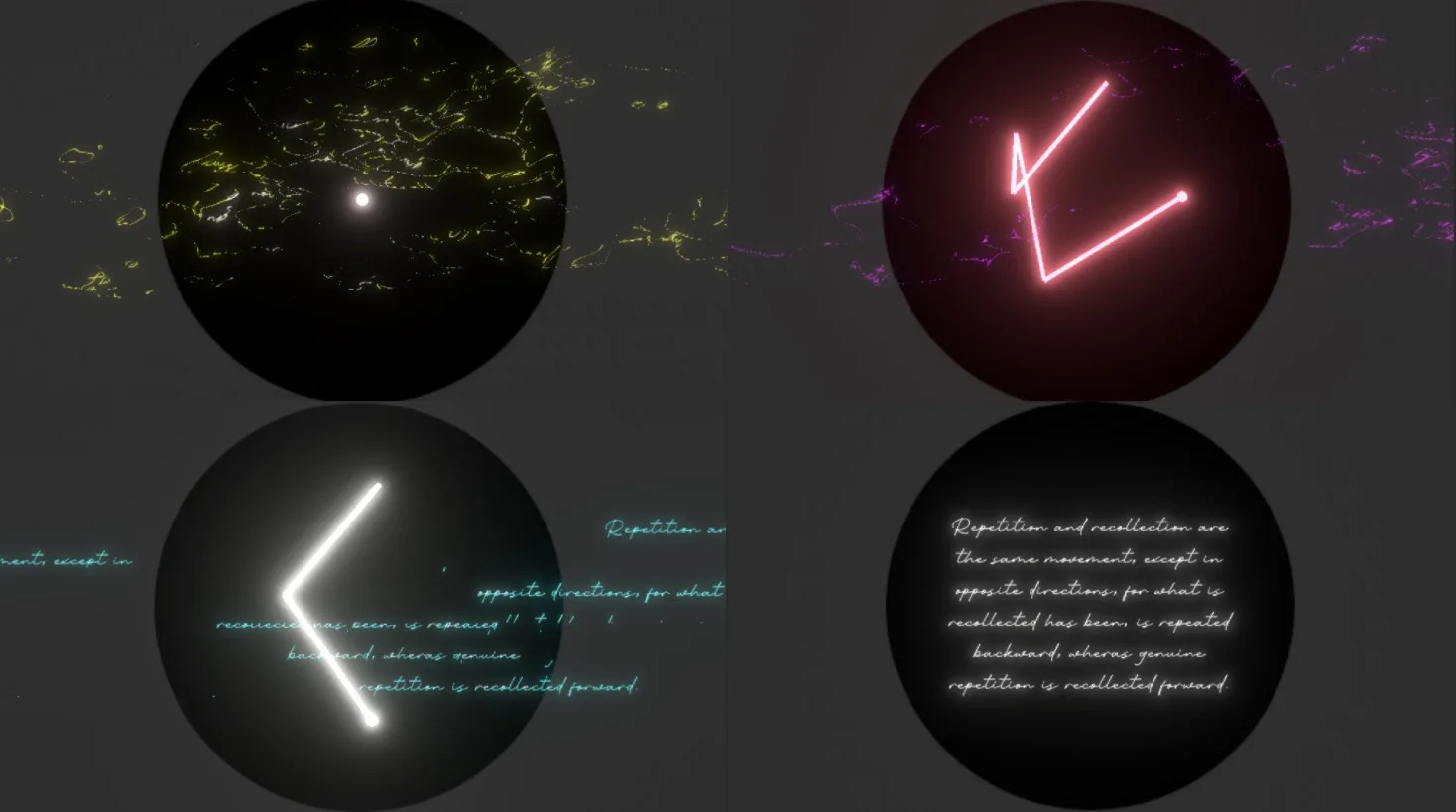
Partly this is because of a few breakthroughs in the concept. I like the idea of the node-discovery also uncovering some sort of visual element (leaning more into the puzzly parts of this), and after thinking about what this could be, I settled on written text. The question of "what text to use" always poses a problem. Generally, I'm not super excited about doing the writing myself, so I could ask someone else to contribute, but then I'm beholden to their timeline and output. So, finding some existing text is the easier way to go here. After some poking through my books I settled on Søren Kierkegaard's essay Repetition1.
Once this was settled, I reimplemented the Limitless Glitch effects from LTHC, and now we're in business! There's an opportunity here to randomize the effects that are applied, but I think at first I will just have the user progress through effects as they find the nodes. Then, once all the nodes are found, the constellation will fade out, leaving the text for a given amount of time, before it collapses in on itself, becoming the starting node for the next "puzzle." And these just keep going and going. Repetition. Some users might walk away after working out one of these, but the hope would be that these function almost more like a labyrinth, where traversing the space in a semi-prescribed way leads to a contemplative state. Lofty goals!
In the next couple of days I want to think/write more on the repetitive nature of this (especially in relation to contemplative practices), but for now we'll leave it with some thoughts on next steps:
Next
- Test building this whole experience out onto the Raspberry Pi. If I can learn how to better use the Pi as a deployement device, I feel like my life will be better...
- Sketch out and start building the case. I'm just going to use the existing LTCH one and chop it up, so shouldn't be too much to get this going.
- I generally think this is going to be better if I create the displayed text elements in Photoshop2. Partly this is so I can stylize them better, but also I want to experiment with splitting the whole thing up into five chunks that are also being manipulated by the dials. I have the feeling that will look cool and feel good.
- And then, yes, I should really work on the audio...
Text Content
- Repetition and recollection are the same movement, only in opposite directions; for what is recollected has been, is repeated backwards, whereas repetition properly so called is recollected forwards.
- For a cultured person, seeing a farce is similar to playing the lottery, except that one does not have the annoyance of winning money.
- One sits down upon a chair by the window, one looks out upon the great square, one sees the shadows of pedestrians hasten along the walls.
- Everything is transformed into a theatrical decoration. A dreamy reality looms up in the background of the soul.
- Midnight is past. One extinguishes the candles, one lights a small night lamp. The moonlight triumphs unalloyed. A single shadow appears still darker, a single footstep takes a long time to disappear.
- The cloudless vault of heaven seems sad and meditative, as though the end of the world were past and heaven undisturbed were concerned only with itself.
- One goes out again into the antechamber, into the vestibule, into that little cabinet, one goes to sleep - if one is of that fortunate number that can sleep.
- My discovery was of no importance, and yet it was a strange one, for I discovered that there is no such thing as repetition, and I had convinced myself of this by trying in every possible way to get it repeated.
- The older one grows and the more understanding of life one acquires, and taste for the agreeable and ability to relish it, in short, the more competent one becomes, the less one is content.
- By firmness of purpose and by dulling one's talent for observation one can attain a uniformity which has a far more anesthetizing effect than the most capricious diversions.
- Time becomes stronger and stronger, like a formula of incantation.
- I am adrift. Repetition is too transcendent for me also. I can circumnavigate myself, but I cannot erect myself above myself, I cannot find the Archimedean point.
- I am expecting a thunderstorm . . . and repetition. Yet - if only the thunderstorm were to come!
- At the very thought I am joyful, indescribably blissful - even if my sentence were to be that no repetition is possible.
- I am again myself, here I have the repetition, I understand everything, and existence seems to me more beautiful than ever.
- It is over, my skiff is afloat, the next minute I am where my soul's yearning was, where the ideas foam with elemental rage, where thoughts arise boisterously like the nations in migration.
- There is a stillness like the profound silence of the South Sea, so that one can hear oneself speak even though the movement goes on in one's own interior - there where one every instant stakes one's life, every instant loses it, and wins it again.
Repetition, Instauratio Exiguus
It dawned on me during the making/testing/thinking about this that repetition is a fundamental concept here. Partly this is just the nature of the game (or lack there of?). The player finds 5 nodes in succession with the sound pitch changing slighty to indicate the proper location. This search also aligns and uncovers text in the background. Once all 5 are found, the constellation is drawn to the center of the screen and the text is revealed. Then it fades out and we start again. Repeated forever; without change. I could have built a progression (in face the original idea was to have each constellation play a unique sonic fingerprint), but I think the concept is stronger as repetition. Ritual. Process. I am reminded of labyrinths, where the act of walking, of being in the moment, the process, the act, is the whole point. This stands in direct contrast with "games" where the point is to culminate in some final "win" state, but not with play, where the point is to be in a state of play.
After deciding on this theme, I then chose Søren Kierkegaard's essay "Repetition" as the source for the on-screen texts. Initially this was just because duh, but there are some great lines here. This wasn't one of his essays I had read before, so it was nice to step back during the making/coding process and think through the idea through his lens. He has a totally different take on it which adds some complexity (and a bit of opaqueness) to the experience. Todo: read one or more of the many essays that discuss Kierkegaard's "Repetition" and write a more in-depth journal entry on the essay itself and how it related to the themes of this project
Lastly, I was unhappy with the anagram name that I've been using for this, and wanted to find something more apt. I happened upon the word instauratio which is a latin phrase used in ancient Rome for the repetition or redo of a religious rite. So when adding the modifier exiguus, we get "a small repetition" which I think is fitting.
So much happened between the last commit and now. I'm doing a bad job at this...
Ludodrome Reflections
Success! The case unfortunately got a little scuffed during the transportation, but luckily it was pretty dark in there, which worked in my favour. Speaking of transport, being able to carry this entire thing (cables and all) in a backpack is so great. From now on, I always want to make work that is this compact. It makes the whole experience of showcasing that much easier. Next step would be to get the wiring and computer aspects more compact, which involved thinking about using a Raspberry PI and/or Mac Mini.3
As far as the reception, I think it went rather well. I described it as a "sonic safecracking" mechanic, which people immediately got. Only a few people had difficulty with hearing the changes in sound, which lead me to think that are perfectly as subtle as I intended. The screen doesn't show the color change very well (even though I bumped up the colour to full red), so another visual indicator would be helpful. This could be by getting brighter (via the bloom effect?), more opaque, or some sort of shaking perhaps? The first node is definitely the hardest to find, so it would improve the experience by having that first node's target area a little bigger. Also, it might be nice to have some sort of countdown mechanic to indicate how many nodes there are left to find (perhaps hash lines or shapes, to avoid straight numerical representation) With this in place, there would also be the opportunity to create 'levels' where there are different numbers of nodes.
One person in particular spent about a half hour playing the game and really did seem to get into a contemplative state. He closed his eyes at certain points, using the sound alone to find the nodes. Remarkably successful! I tried this myself during a break, and it felt really good to do it that way. It's shocking how rewarding the text reveal feels. People are immediately excited to see it, and it definitely seems to be enough of a payoff for them to keep going, which is a happy unexpected thing. I didn't plan on a "sticky" experience, but just this little bit of reward makes it work.
A final interesting note: many of the people asked where the idea came from, and I kept finding myself referring back to LTHC which is kind of weird? Rather than talking about it as it's own standalone thing with its own design goals, I felt the need to talk about it in context with the bigger work trajectory. I don't know if this was a successful way to discuss it (especially needing to show the older project documentation from my phone4), but it definitely cemented in my mind the relationship between the two projects. I wonder if Love Hulton thinks of his various pieces as working or living in community with the others? Does one type of synthesizer emerge from another? Do his ideas build off of each other? Probably?
I would definitely show this again (which is not something I usually say) so I'd call that a win.
Next
- Touch up the paint
- Get good documentation imagery
- Write up a good project description
- Add it to the work section of the website
- Think about if I really do want to show this again, and if so implement some of the changes listed above
Notes
- Which I've never even read, but the potential links to the repetitive nature of the work is too good to ignore. Hopefully I won't read it and immediately regret my choice
- Photopea actually, because the University keeps taking away my Adobe credentials...
- I hadn't mentioned earlier, but this actually brings to mind the issue I faced with the Mac Mini. Sort of a boring story, but worth noting that Unity 6 only exports to Mac OS 13+, and my old (2014?) Mac Mini is maxed out at OS 12. Obviously, I can just buy a new Mac Mini moving forward, but it also feels like a waste not to use the one I have. All that being said, I should plan to use an earlier version of Unity if I evr plan on using the old Mac Mini for an exhibition. Remember!
- Though I suppose this was a good way to point people towards the website since the Ludodrome people used my name instead of Mouse & the Billionaire, and I forgot business cards like an amateur