
It is as if you were making love - Design Process Analysis
By Vadim Nickel
Re: It is as if you were making loveSeptember 15, 2026
Introduction
Pippin Barr’s “It Is As If You Were Making Love” (LOVE in the following), is a satirical short-form browser game in which the player navigates the act of giving sexual pleasure to a user interface in the style of bygone office software. LOVE originates from a speculative play angle that envisions a future where physical intimacy is rare, and people crave the feeling of giving sexual pleasure. In LOVE, a Windows 95-era interface serves as an invitation to provide pleasure to the software at hand. The player’s sole task is to “stroke” a slider according to the instructions given by the program. As the software goes through several stages of arousal, it requests the user to provide input within certain value ranges and different speeds. If the player follows these instructions successfully, the interface reaches its climax, represented by visuals evoking a winning moment in a 90s version of Microsoft Solitaire, paired with some raunchy communication, a seeming crash, and a reset, until inviting another round of interface innuendo.
Ideating, speculating, questioning
The first evidence of Barr’s design thoughts for LOVE is a high-level concept that presents deliberations about look, feel, and meaning. It features descriptions of the basic game design premise, context, UI, and the essential elements for building a prototype.
Figure 1 shows the opening excerpt from Barr’s concept for LOVE. The title lays it out clearly: UI SEX GAME – three words that denote what this project is intended to be about. The reader can reasonably deduce there to be a focus on user interfaces, i.e., the mode of interaction, sex, i.e., the theme and conceptual framework, and game, i.e., the type of interaction – this may be playful.
“There would be a slider.”1 Barr’s opening statement focuses this specific interaction element, accompanied by a sketch of it. Next, one can witness the first instance of Barr’s habit of constant questioning. As in the present entry, he quickly challenges new ideas and suggestions with questions. Here, he addresses the basic gameplay loop, “It tells you where to set it?”, and how it may be communicated to the player using affordances that integrate with its conceptual framing: “How do you tell someone to masturbate a slider in UI language?” Seemingly trying to find answers to these questions, Barr turns to the game’s conceptual framework and uses that as a relay towards reference work. Here, Barr recalls another short-form browser game featuring masturbation, Sepe’s Cumshot2, wondering how LOVE sets itself apart and leading him to question the focus on male masturbation in both his and the reference work.
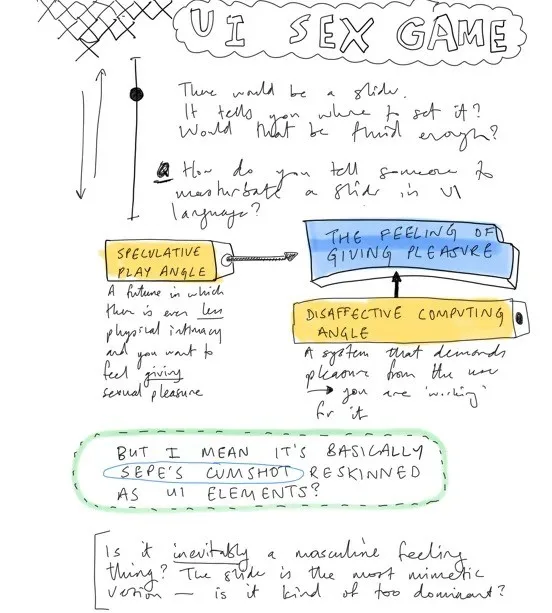
This demonstrates a recurring moment in Barr’s design approach: When the existing material appears insufficient in answering the questions raised, he expands the scope of inquiry. This entails an exploratory “yes, and” approach, where one inquiry may lead to another, resulting in a chain of reasoning, eventually producing responses that may close the gap. This is apparent in the remainder of the first entry, where Barr’s thoughts on UI feedback led him to explore alternative interaction modalities, eventually refocusing on the original slider concept and stabilizing the approach by listing specific aspects of game behavior and player interaction, informed by the preceding chain of inquiries.
Despite the section discussed here being only one-sixth of the full entry’s length, it represents the first occurrence of a design loop: Barr’s explorations seem to venture from an initial idea that then spawns deeper inquiries, before returning to the original thought with a more concrete answer, informing subsequent choices.
These loops occur not only within self-contained instances of deliberations but may persist throughout several stages of development. In this opening phase of LOVE’s development, Barr’s explorative approach leads to the project’s expansion in scope through new interaction modalities, technical features, and trying to satisfy the speculative framing. However, this path toward eventual closure of the loop comes with confounding moments, as the following section will highlight.
Navigating surprise
Barr frequently describes moments of misalignment between expectation and outcome. These surprises occur throughout all project aspects and can be of experiential, technical, or conceptual nature.
At times, he anticipates such moments. For instance, once Barr provides the first complete description of the game flow in LOVE, he acknowledges that his initial assessment may overlook something: “Doesn’t actually sound like it needs to be especially complex? Ha ha, famous last words.”3 In another moment of anticipation, Barr contemplates the inclusion of overlapping pop-up dialogs, while immediately realizing how this may cause issues on mobile devices.4 This suggests a strong sense of material familiarity in game design and development, further supported by Barr’s extensive body of work.5
However, Barr may also avoid fully resolving an anticipated or experienced confounding moment in favor of a generative approach. For example, once Barr settles on Windows-95 era aesthetics for LOVE, he begins “to re-question previous ideas around outputs and indicators.”6 This results in another series of questions on UI feedback, not all of which are fully answered in advance. Instead, Barr opts to “implement some of these ideas more simply and see what happens.”7 This indicates that regardless of experience, a design practitioner may decide to not resolve all questions in theory but instead need to experience a design proposal in its materialized form in order to make informed decisions.
Barr’s implementation thus presents a form of inquiry – experiencing it helps determine what should happen next. This is in line with what Schön (1992) describes as seeing-moving-seeing, in which a design move changes the situation and makes further qualities available for interpretation.8
This is especially relevant because LOVE is a digital game. A focus on individual elements during design and implementation may strongly contrast with the dynamic experience that emerges from the interactions with and between these elements. Barr constantly revisits and evaluates the materialized design outcomes. This may lead to exceeded expectations: “Just sliding the slider on mobile feels surprisingly good.”9 It may also reveal potential for improvement in aspects that involve multiple design elements, such as the game’s orgasm mechanic. Barr’s experience of the game’s input modality and guiding communication reveals: “There’s a problem, I think, with the pacing of [the orgasm].”10
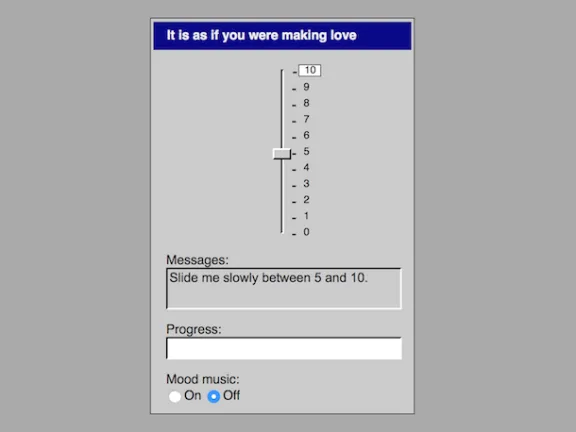
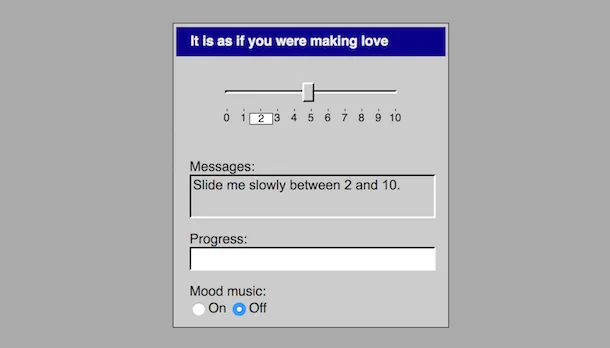
External feedback further supports evaluating intention vs outcome. It can expose meanings that may otherwise elude the designer within their own frame of reference. Barr frequently discusses LOVE with colleagues, students, friends, and family, which establishes external reference points that may help reduce personal bias or blind spots. A substantial redesign of LOVE’s main interactable element occurs after Barr receives feedback from his mother: After experiencing the game, she reports that the “game felt like being in service to a male, rather than [Barr’s] goal of the game feeling like giving pleasure to a more ambiguous entity.” Addressing Barr’s previous concern prompts him to rethink the slider’s vertical orientation and instead switch to a horizontal design.11
These moments of alignment and misalignment seem to be important drivers of Barr’s transition from expanding the project’s scope to narrowing it.
Focusing and grounding
During the first phase of Barr’s work on LOVE, the project’s scope appears to be growing. As Barr opens and responds to an increasing number of design inquiries, he adds new features, which come with their own sets of technical challenges and questions of conceptual alignment. When Barr returns to the project after a one-month pause, he admits to being held back from finishing due to having a lack of clarity about “what it is, what it does, what it’s for” and that his enthusiasm for the project has waned. Nevertheless, he sees merit in the fact that the project’s premise resonates with others.12
Barr reiterates LOVE’s design goal of facilitating “humans in feeling like they’re giving pleasure to someone/something.” He acknowledges that “one answer to this is that therefore the pleasure-giving should recreate the complexities and subtleties of real lovemaking, in order to seem more authentic.” However, as he recognizes that maintaining subtlety through difficulty and complexity may conflict with the “erotic thrill of pleasuring,” his focus shifts toward centering the affordances and feedback of the interface itself.
Barr himself seems to imply here that there can be several answers to the same inquiry. This is supported by his exhaustive responses to a given question, especially in the early phase of the project. At the same time, Barr’s meandering inquiries may lack a definite solution, and navigating such multiplicity in the pursuit of one definite answer may lead to a loss of focus, as witnessed above. He does not simply dismiss the roads not taken but instead acknowledges them consciously, providing a rationale for his design decisions that ultimately result in a narrowing of the project’s scope.
Barr’s focus on a specific conceptual aspect gives him “permission to massively simplify the way [he is] thinking about this game.” He further states that “the shift to the Windows 95-esque aesthetic helps with that”13, indicating that aesthetic grounding supports further consolidating decisions. Here, aesthetics narrow the solution space, since Barr now consciously limits himself to using a reduced set of available sounds and visual elements. Barr’s choice is no coincidence but marks a return to the familiar, as he took this aesthetic direction in a previous game, It Is As If You Were Doing Work (henceforth WORK): Here, Barr adopted the Windows 95 style to support the intention of making the game feel and “look like work” through its office software-like appearance.14 In LOVE, however, this visual context serves a “humorous tension between the erotic charge and decidedly non-erotic Windows 95 interface […]”,15 while exploring another angle of speculative play. LOVE is now becoming a streamlined experience, featuring a simple gameplay loop of following instructions to slide a slider between changing value ranges at different speeds.
This aesthetic commitment marks a turning point in the development of LOVE: After widening the scope in a phase of consistent expansion through the exploration of various design concerns, Barr moves on to consolidation. What follows is a focused implementation phase that lasts almost three weeks, features the most commits, and, beyond minor tweaks and fixes, produces the final build. Now that Barr seems confident in how he addresses the speculative framework, final decisions are being made.
For instance, an earlier inquiry into additional UI interactions and exchanges with his students about the power of sound and speech initially prompted Barr to add voice input to LOVE.16 However, after having encountered several technical issues around its implementation, he decides to cut the feature, grounds this decision in the conceptual and aesthetic framework, it being “too high-tech and […] too intimate”.17
These moments signify a return of answers to previously open inquiries. As LOVE nears completion, the newly found answers support a reduction in scope, such as by removing a feature or simplifying a conceptual framing. Barr increasingly decides which questions belong to LOVE, and which do not. This leads to stabilization that embeds the answers within the final materialized response. This can be seen when Barr removes positive feedback and text input dialogs.
Barr previously introduced a text input dialogue as an interruption of the game flow that allows players to express themselves differently.18 However, testing had led him to realize that this was undesirable: positive feedback interrupted successful play, and text input pulled the game in a different direction.19 Now, instead of following up with new inquiries to try and integrate this feature, his arrived-upon conceptual understanding informs its removal – sorting out the conflict between design decisions eventually makes way for synergies.
What follows is a tying up of loose technical ends, debugging and tweaking, and eventually publishing the final build.
Closing the loop
LOVE’s gameplay loops back into itself, much like the design process of its creator. As outlined above, design inquiries in Barr’s journals tend to move through cycles. Proposals are generally questioned and iteratively developed. They may remain merely theoretical or become part of a refined materialization.
As the designer processes the various inquiries throughout such loops, they progressively focus in on a design implementation through cycles of ideation, evaluation, and surprise, while negotiating conceptual, referential, and technological constraints. As individual inquiries lead to inquiry loops, they are of an inherently recursive nature.
Barr’s chains of reasoning use the conceptual framework as generator for new ideas and filter for resulting materializations of design proposals and inquiries. The interconnected nature of these design inquiries demonstrates how design choices create ripples that propagate within and across domains. Some outcomes may be anticipated; some arrive as surprises that show misalignment between expectation and outcome. Some outcomes must be experienced to make an informed decision, others require, or benefit from external feedback to help the designer navigate their own biases and blind spots. There are often multiple answers to an inquiry, and an explorative design process may help to make informed decisions that intentionally include certain options, while excluding others. In LOVE, repeated evaluation appears to bring the game’s technical, conceptual, and experiential aspects into sufficient alignment for Barr to consider it complete.
It is as if there is a moment when everything falls into place.
Footnotes
-
Barr, P., LOVE Design Journal, March 24, 2018. ↩
-
Yang, R., 2012. ↩
-
Barr, P., LOVE Design Journal, GitHub, April 9, 2018, 2:15 pm. ↩
-
Barr, P., LOVE Design Journal, GitHub, June 6, 2018, 7:17 am. ↩
-
See https://pippinbarr.com/games/, https://github.com/pippinbarr?tab=repositories. ↩
-
Barr, P., LOVE Design Journal, GitHub, May 6, 2018, 6:39 pm. ↩
-
Ibid. ↩
-
Schön, D., Designing as Reflective Conversation with the Materials of a Design Situation, 1992. ↩
-
Barr, P., LOVE Design Journal, GitHub, May 9, 2018, 9:48 am. ↩
-
Barr, P., LOVE Design Journal, GitHub, June 12, 2018, 6:23 pm. ↩
-
Barr, P., LOVE Design Journal, GitHub, June 15, 7:17 am. ↩
-
Barr, P., LOVE Design Journal, GitHub, June 4, 7:33 am. ↩
-
Ibid. ↩
-
Barr, P., “It is as if you were back to work”, June 10, 2017. ↩
-
Barr, P., LOVE Design Journal, GitHub, June 18, 2018, 7:42 am. ↩
-
Barr, P. LOVE Design Journal, GitHub, April 12, 2018, 11:52 am. ↩
-
Barr, P., LOVE Design Journal, GitHub, June 4, 2018, 7:33 am. ↩
-
Barr, P., LOVE Design Journal, GitHub, June 6, 2018, 7:17 am. ↩
-
Barr, P., LOVE Design Journal, GitHub, June 23, 2018, 9:37 pm. ↩