Design Problem Solving as Katamari Damacy
By Rilla Khaled
Re: It is as if you were on your phoneAugust 6, 2026
Knowing and Not Knowing
We take for granted that design concepts are linked to their designers: Pippin Barr had an idea about making games about unremarkable life experiences, and these led to him creating his own micro-genre: “it is as if…” games.
Yet everything we know about how design problem solving happens implies a far more complex dynamic at play between designer and design concept 1 2 3. A design concept may originate from a designer’s imagination, but this does not entail that designers initially understand their concept – or indeed, what it will eventually become. A concept that exists in imagination only lacks material form. Devoid of material form, the concept is unmaterialized. It is difficult to predict material consequences of unmaterialized concepts. When granted material form, the concept becomes something else.
Herein lies the paradox: designers both know and do not know their unmaterialized concepts. Materialization implies a crossover of a threshold between imaginary and real. Materiality introduces material consequences. Designers weigh up material consequences and adopt a most appropriate material form through the course of design activity, which is ever framed by context.
Designing as Navigating
Ontological metaphors designers use to express their design reasoning frequently evoke orientation and navigation, as if they are seeking to get somewhere. If the designer’s navigation problem is a search expedition, then the location of the search is the solution space:
My main feeling, though, is that the project is
on a good trajectory that I can handle” 4.
“...in terms of the environmental design, I'm glad to know
I'm on the right track here” 5.
It’s a strange navigation problem, though. The quotes above are from the design journals of two different designers. Designers often don’t know from the outset where they are heading. They may have some idea of where, but their directions are incomplete. Precise coordinates of their destinations are hard-won: 20/20 in hindsight; 20/200 in foresight. Which invites the following question:
how does design activity support the search behaviour of designers?
Locating Target
A simple answer might be to say: they use their extant experience and tacit knowledge to fuel their understanding of concept. We find evidence of Barr doing this in his Phone archives journal:
“This is where the sort of metanarrative of the game comes in I guess.
Much as in the previous two... the idea that it's atool with a purpose. In this case my working theory (which I really like) is that it's a tool both to look like you're on your phone (and so a NORMAL PERSON) but also to NOT be on your phone and thus not subject to the abject terrors and punishments of social media and the news and so on...” 6.
When Barr writes “previous two”, although we can’t be sure which games he is referring to (his GitHub repository turns up seven projects in response to the search query “It is as if”), since he specifies “tool with a purpose”, we may reasonably guess he is referring to It is as if you were doing work 7 and/or It is as if you were making love8. Referring to the archives of these two games enables us to compare their materials and designerly reflections to that of Phone.
These archives highlight the following about It is as if games:
- Barr seems to be drawn to designing play experiences that liken life experiences (i.e. computer-based office work, physical pleasure) to manipulation of GUI elements spanning the last three decades
- These games are single player, minimal in terms of narrative and aesthetics, and sufficiently simple that they can be readily engaged with by players outside of typical gamer communities
These traits turn up in Phone too.
But previous work is not the only factor influencing Phone: if this were true, designers would only ever make sequels of their previous work. This would suggest, for instance, that Phone ought to anachronistically feature Windows 95 aesthetics (it does not). Besides, it is clear from early journal entries that Barr’s concept is tethered to thematics on which he does not yet have a set position:
“
I don't like the idea of simulating a specific app experience, but I think it's true that there are kind of higher level organizatinos (sic) that are worth preserving right?Like swipe down then double tap, swipe down then double tap (Instagram where you're liking pictures), or swipe right, scroll down, swipe left, etc...” 9.
The materials in Barr’s repository for Phone demonstrate two patterns:
- Quantity of design materials or components. There are fewer at the start, and many at the end.
- Co-dependency between concept and materials. It is weaker at the beginning, and stronger at the end.
In fact, this same pattern turns up in (many) other design projects: see, for example, the archives for Matthew Bethancourt’s lest Ten Horizons Cry 10, Adrian Demleitner’s Ostrakinda 11, Vadim Nickel’s Soundgarden 12... etc. If we were to diagram these patterns against one another and against time, they look like this:
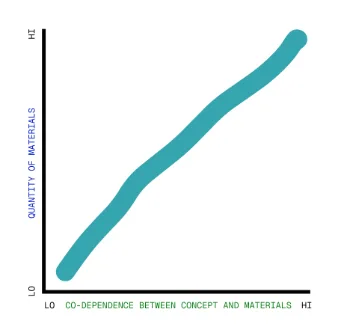
These movements look correlated. We will revisit this relationship later.
Dying on Which Hill?
Let’s pick up a Computer Science metaphor to think through what happens during design processes13. Hill Climbing algorithms refer to a class of heuristic-based search algorithms that seek the highest point within a solution space, as the highest point within the space represents the best solution. These algorithms attempt to keep bettering their current location by traversing towards nearby locations that have a goodness value better than the value at the current location, where the goodness value is intended to approximate the goodness of the solution. While what is ultimately being sought is the best possible solution, these algorithms proceed by searching for the best goodness value. In which case, how the goodness value is calculated is crucial. Applying the hill climbing lens to design problem solving, Barr’s broad, existing design intuitions based on experience – his tacit knowledge – serve as a form of goodness value to orient him towards paths of future possibility, i.e. I’ve encountered this type of design problem before. From previous experience I know which types of solutions were generative, so I will extrapolate that knowledge to my current problem context.
The efficiency of hill climbing algorithms is connected to how they are not assessing the goodness values of every point in the solution space before making a judgement about where to go next. They are only making judgements based on nearby points. But this strength also sometimes acts as a weakness. Vantage is based on current location, therefore current location determines what one can see. This leads to hill climbing algorithms getting stuck in local maxima - areas within the solution space higher in value than anything else nearby, though not necessarily of equal value to the global maxima (and thus not actually the best solution)14. What might appear as the best solution may only seem so given the current context.
A corollary of local maxima in the context of design problem solving is design fixation. Described by Jansson and Smith in 1991 as “a blind, and sometimes counterproductive, adherence to a limited set of ideas in the design process” 15, design fixation results in pursuit of suboptimal design solutions. There may be pragmatic reasons why one (class of) solution must be adopted, for instance, when back compatibility is required or legacy systems are involved. But design fixation does not describe these situations: rather, it is when designers choose not to pursue potentially stronger alternatives. Additionally, Jansson and Smith point out that pursuing a limited set of ideas is not in itself indicative of design fixation: what is deemed limited is defined against the full backdrop of a designer’s experience. A novice designer might appear to be caught by design fixation due to pursuing a small number of ideas, but the limited size of their database of design experience plays a significant role in what they are able to extrapolate. Design fixation, then, is a phenomenon more pertinent to designers with sufficient experience; ones who literally know better. A follow-up study conducted by Condoor and Lavoie in 2007 emphasized that design fixation affects designers of all levels (seasoned and novice alike), and pointed out that all designers struggled to “move away from the prototype”16.
Doubling Downm
The psychologist Robert Zajonc named the human tendency to view that which they are familiar with in a more positive light as the mere-exposure effect 17. Framed in the context of design, the mere-exposure effect suggests that known (i.e. lower risk) solutions are rated positively, while unknown (i.e. higher risk) solutions are rated negatively. Sunk-cost fallacy turns up here too: if time is money, and effort is time, then spent effort = fat stacks that won’t come backs 18. When design fixation strikes during hill climbing, goodness value is hijacked by familiarity and cost, instead of what it is intended to be based on: approximations of solutional goodness19. Worse, it implies a local maxima. Worse still, that one is stuck in it.
How, then, do designers extract themselves from the local maximal quicksand that is design fixation?
In short, they must notice that it is happening. Barr’s style of reflective journalling involves wayfinding through questions, the practice of designers asking themselves questions during design time as a navigational aid 20:
“
I'm concerned by the tension between relief/social camouflage and the gamified version where it seems like it would be very stressful. Why would you play this as a game specifically? There's some way in which that ends up feeling too close to the real experience?Am I just concerned that without some gamified element people won't see the point in interacting longer term? But if it's an application, then it's not really intended to be played in that way - it's a tool not a game?” 21
These questions directly identify conflicts that co-exist within his current concept. This suggests that at the time of writing, he was still entertaining competing logics justifying different responses to those questions, i.e. those logics had not yet been organised into a hierarchy of precedence. Barr is taking pause at this intersection: he sees multiple paths ahead, but cannot yet tell which is more promising. But it’s not just that he is at a crossroads: if his navigation instructions had been more appropriate for the solution space, he would not have encountered that crossroads. Barr is thus concerned by the inconsistency within his current grasp of concept. His hesitations with the concept are further evidenced by a later journal entry recalling an attempt to implement a double tap mechanic:
“As I started trying to "easily" "breezily" implement double taps it felt like the moment that
everything would break apart (mostly my mind) in terms of the structures at play.”22
Barr’s mechanism for extracting himself from fixation is to establish careful rules of engagement for how to venture into unchartered territory. As is emblematic of his style of design problem solving, Barr leans on his technical infrastructures to illuminate a path forward.
But this means he must first take a few steps backwards.
Extracting by Refactoring
Directly after writing the above, he writes:
“It spiralled me out into
thinking (fantasizing??) about OOP and inheritance and a beautiful clean cool implementation of All This.” 22
At this stage, the benefits of shifting over the code base to an OOP implementation come across more as an aesthetic fantasy, or indeed a delaying tactic23 for making decisions about the conflicts mentioned above. Over the next five days, he refactors his ad-hoc codebase in keeping with an object-oriented programming (OOP) structure. Having rematerialized his concept as an OOP implementation, the tone of his journal entries take a turn:
“it feels much more like
there's an alignment between implementation and the spirit of the project… in switching programming paradigmsI'm finding a better way of thinking about/expressing a part of what this whole thing is about, which is the desire we maybe have (sometimes?) to be more like computers doing computer things in computer ways”24
Having adopted an OOP implementation directly impacts on Barr’s way of perceiving the solution space – both what it constitutes, but also where good solutions are afforded. It becomes an additional lens through which he is assessing goodness values. The benefit of the OOP implementation for Barr is not just what it allows him to understand, it is also how it allows him to act. It becomes the language he uses to materialize and express and extend his concept, evidenced when he says, “the desire we maybe have (sometimes?) to be more like computers doing computer things in computer ways”. This is the first time Barr has presented this sentiment — and this only happens after he has spent time concertedly and consistently expressing the concept in a form that can be compiled by a computer. The Sapir-Whorf linguistic hypothesis posits that the language we use shapes what we want to say, and reciprocally, what we want to think25. Barr’s OOP implementation plays that role here: he must work within the syntactic and semantic constraints of OOP. Future design decisions become framed by OOP. For instance, his implementation of Acts prompts him to make decisions about pragmatic details, such as timing:
“
How often do you switch activities?- I suppose just often enough for it not to be excruciating? Some of that is about the support the Acts do/don't offer to things” 26
Accelerated Clicking
A designer’s ability to be appropriately expressive in their materials of choice can be correlated to their density of confidently-made design moves that are internally consistent with one another: we have previously characterised such moves as conceptual clicks 20. In military jargon, click also serves as a unit of measurement. Incorporating this other meaning of click, Barr’s high density of clicks entails accelerated traversal of the solution space, enabling him to cover more ground quickly and gain momentum:
“It was really pleasing to implement a Dating activity with a minimum of confusion and difficulty thanks to the framework I'd set up for the Browsing activity.
I was able to just add a set of classes that represented the approapriate (*sic*) swipes and then it kind of just worked without too much difficulty” 27.
In interaction design endeavours, until designers experience their concepts in their intended implementation environment, uncertainty remains about whether those concepts are viable. The OOP implementation enables Barr in knowing that his evolving concept remains aesthetically viable:
“
Let me pick up my phone now and do some "dating"... It felt... pretty great at a base level? I continue to feel like the core project here makes sense.” 28
Barr’s adoption of OOP thus acts as a turning point in his design trajectory. It enables him to smoothly yet systematically externalize the interaction experience for which he previously held only a partial, conceptual understanding. Barr’s design concepts herein become expressed as — and thus embodied through — core materials. For Barr to continue building his code base efficiently, all future extensions of concept must be materializable via his code base:
“Interaction Sequencing - Right now interactions have probabilities of showing up but
they're not actually sequenced in a way that would build a sense of a well-known interaction(e.g. scrolling Instragram (sic) is like: look look doubletap scroll down look scroll down look look look scroll down scroll down look doubletap -- or something);having a kind of "grammar" of interactions sounds pretty cool but also really tiring, but also maybe what I should be doing... at worst could just be selecting from an array of atomic interactions that deal with "one media unit" or something? Regular expressions?” 26
This, in turn, flavours how future design decision making happens, with greater weighting and priority given to design extensions suggested by, supported by, and/or integratable with existing infrastructural materials. Barr’s understanding of the concept post OOP implementation is granted substrative materiality by his OOP materials, whereby substrate is intended to evoke underlying surface, or foundation. The material of Barr’s substrate — his OOP implementation — plays a strong role in shaping the behavior of consequent layers of material that rest on it. A designer’s choice of substrate shifts the locus of best possible materialization of concept to solutions afforded by that substrate. Returning to the hill climbing metaphor, the coordinates from which Barr is searching for a best possible materialization of concept now cluster around a space that supports not only possible OOP solutions, but generative ones.
Worth exploring is whether any materials Barr used during the process might have equally served as his material substrate. In his second journal entry, Barr speculates on what type of feedback feel to pursue, in relation to an aspect of the initial game concept — a “zen” feeling:
“My inclination as of right now is to
lean into the kind of "Zen" conceit involvedhere and tomake the sounds simple chimes or other zenny sounds (gongs?). Some way of continuing the emotional tone of calm, sort of trying to catch onto the seeming calm of this kind of phone use, but making it actually calm, but making it still engaging? Soprototyping some sound formats makes sense, starting with Zenning” 29
Although Barr declares an intention to prototype sounds, this does not happen. Once he begins refactoring, his attention shifts elsewhere. As we see later, the entire zen aspect of the game concept is ultimately dropped. Why, then, does the OOP implementation exert substrative materiality while, for instance, sound design does not? A designer’s gravitation towards a particular material substrate will be heavily influenced by their design values: see 30 for a robust overview of motivations driving designers. From Barr’s other GitHub repositories, we find ample evidence that he commonly relies on technical implementations as a way to generate his design concepts, i.e. they are his “go to materials” (presumably because he is highly fluent in them). Designers’ substrates are also filtered by their experience and tacit knowledge.
Pulling into Orbit
Newton’s second law of motion states that bodies exert forces on each other:
f = m x a
A body with larger mass than another body exerts more pull on it, pulling that body towards it. Something similar happens with the pace of how Barr’s concept suddenly coalesces, all while the code base continues to grow. At the start of a design process involving few externalized materials, a designer’s initial understanding of their design concept is uncertain – not least of all because it resides largely in their head. Designers who are very experienced with certain materials might have enough conceptual foresight to predict the consequences of future design moves involving those materials without needing to rely on material experiments 31. But if an initial design concept (or material environment) is sufficiently novel, accurate conceptual foresight is less likely. A novel concept entails lack of conceptual clarity or substance, akin to a body with low mass. A body with lower mass will exert lower pull. Follow-up internally consistent design moves are harder for the designer to make (and thus absorb into the initial concept), because the initial concept does not yet exert enough pull.
As the design process continues, the center of a concept’s mass transitions to its material substrate: the design materials that seemed most promising. With a viable substrate in place, the concept grows in terms of mass and clarity.
Rolling Katamari Gathers Mass
The conversational phrase real and material consequences expresses an unequivocal (if ominous) message: actual things will happen as a result. It likewise resonates with what takes place after a design concept has been given substrative materiality: the designer can more confidently predict consequences, on the basis of design moves involving established materials. The substrate exerts pull on other simpatico ideas from the solution space, amassing them into a bundle.
This stage in the design process is evocative of Katamari Damacy. The katamari or ball is the substrate bundle, an assemblage of internally consistent concepts and materials. The designer rolls the katamari around in the solution space based on tacit knowledge or experimentation. If they encounter promising conceptual additions, those are amassed onto the katamari. There comes a point when the katamari has gathered sufficient mass to have a clearly defined identity, boundaries, and material form. At this stage, the katamari will readily attract internally consistent design concepts/materials. From the designer’s perspective, they can confidently and rapidly make design moves — indeed, the moves almost make themselves. The following is a quote from Barr’s journal a few days after has shifted to the OOP implementation:
“I implemented those mockups pretty literally over the last few days and
the game has kind of jumped from feeling a bit off to pretty much feeling like what I wanted? It suddenly feels close to done-- though naturally that doesn't mean it *is* close to done. Crucially I think it seems to work” 32
Forming While Functioning
Remember the graph from earlier, QUANTITY OF MATERIALS VS. CO-DEPENDENCE BETWEEN CONCEPT AND MATERIALS? Notice the general trend: when the quantity of materials is low, the co-dependence between concept and materials is also low. Conversely, when co-dependency between concept and materials is high, the quantity of materials is high.
Over the duration of the design process, there is a clear shift in how Barr articulates his concept: his design concept articulations become increasingly tethered to the materials of his chosen substrate, until his concept and his substrate are inseparable. Once this point is reached, it is hard for Barr to introduce disparate additions to the concept: they cannot easily be integrated into the existing machinery. The katamari will not pick them up. Thus, Barr jettisons the meditative aspect — the zen mode:
“My growing feeling is that
the zen mode just doesn't really work right now. It's too distinct from the main project, it's not about pretending you're on your phoneand I think that if I'm going to pursue it as an idea (using phone interactions as a form of meditation) I need to give it its own space to breathe and be its own thing… so...bye zen!” 33
Louis Sullivan’s famous maxim, form follows function 34 may be relevant in situations when function has been settled. But when function is not clear — as is often the case in experimental design endeavours — form and function, in fact, look to one another for cues. Barr leaned on his conceptualization form – his OOP material substrate – to help him understand the function of his concept. Likewise, he leaned on his evolving understanding of the function of his concept to drive the specifics that his OOP implementation ultimately resulted in (his form). Neither of them made room for zen mode.
Had Barr insisted on maintaining zen mode and centralised it from early on, the resulting game would have been different. This is the lesson learned: if a design aspect is non-negotiable, designers need to prioritize it and embody it in the material substrate early on. Otherwise, they will run the risk of losing it later for reasons of lack of internal consistency: it does not align with the spirit of the design — the designgeist.
Feelsmaxxing not Looksmaxxing
Let’s address our friendly, neighbourhood elephant: Barr never actually found the global maxima. This would be a logical impossibility: design solution spaces remain changeable throughout a design process, thus designers can never find the global maxima. Design thinking is a wicked problem35. Barr jettisoned an entire component of his early concept and still felt as if he had hit his intuitive target:
“
The game has kind of jumped from feeling a bit off to pretty much feeling like what I wanted?“ 32
Barr found a good enough solution — resonating with the filtering qualities of abductive thinking 36, as well as how scholars of research epistemology have characterised the relationship between design and truth: “truth is what works at the time” 37. Barr relied on intuition to drive his sense of how successful design solutions behave. This feeling was not based on time, because the timescale of this project (7 weeks) was shorter than many of the timescales involved in other projects housed in his GitHub repositories. Being “done” is a designerly intuition, premised on a designer’s comparison between their intrinsic vision of conceptual designgeist and the iteration of the concept’s body that is ultimately deemed to be its final form.
Footnotes
-
Nigel Cross. 2006. Designerly ways of knowing. Springer, London. ↩
-
Johan Redstrom. 2017. Making Design Theory. MIT Press. ↩
-
Donald A. Schön. 1983. The reflective practitioner: How professionals think in action. Ashgate, Farnham ↩
-
Pippin Barr. 2025. Nexts. GitHub. Retrieved November 27, 2025 from https://github.com/pippinbarr/it-is-as-if-you-were-on-your-phone/blob/main/process/journal.md#nexts-2025-01-23 ↩
-
Vadim Nickel. 2024. soundgarden process journal. GitHub. Retrieved November 27, 2025 from https://github.com/Videon/soundgarden/blob/f9e122578115c1904a03614a229b2f5e899086f6/docs/2024-12-04.md ↩
-
Pippin Barr. 2025. Who are you trying to fool? GitHub. Retrieved November 27, 2025 from https://github.com/pippinbarr/it-is-as-if-you-were-on-your-phone/blob/main/process/journal.md#who-are-you-trying-to-fool ↩
-
Pippin Barr. 2016. It is as if you were doing work. Retrieved November 27, 2025 from https://github.com/pippinbarr/itisasifyouweredoingwork ↩
-
Pippin Barr. 2018. it is as if you were making love. Retrieved February 6, 2025 from https://github.com/pippinbarr/itisasifyouweremakinglove ↩
-
Pippin Barr. 2025. Sequencing. GitHub. Retrieved November 27, 2025 from https://github.com/pippinbarr/it-is-as-if-you-were-on-your-phone/tree/main/process ↩
-
M. Bethancourt. 2025. mouseandthebillionaire/_lestTenHorizonsCry. Retrieved May 14, 2026 from https://github.com/mouseandthebillionaire/_lestTenHorizonsCry/blob/main/docs/Process/Precedents.md ↩
-
Adrian Demleitner. ostrakinda. Codeberg.org. Retrieved June 11, 2026 from https://codeberg.org/thgie/ostrakinda ↩
-
Vadim Nickel. 2025. Videon/soundgarden. Retrieved June 11, 2026 from https://github.com/Videon/soundgarden ↩
-
What follows is a reasonable question that may have crossed your mind: why should human problem solving be anything like a computational algorithm? There is more in common between how people and computers problem solve than you might think 38. AI has long been a cousin of design studies, as evidenced by Herbert Simon’s The Science of the Artificial , and specifically, his 1969 definition of design that is still routinely used: “devising courses of action aimed at changing existing situations into preferred ones” 39. ↩
-
Take, for example, Mount Royal (233m). It may be the highest point in Montreal, but it’s laughably far from being the highest point in Canada (5,959m). ↩
-
David G. Jansson and Steven M. Smith. 1991. Design fixation. Des. Stud. 12, 1 (January 1991), 3–11. https://doi.org/10.1016/0142-694X(91)90003-F ↩
-
Sridhar Condoor and Donna LaVoie. 2007. DESIGN FIXATION: A COGNITIVE MODEL. In ICED’07, 2007 ↩
-
Robert B. Zajonc. 1968. Attitudinal effects of mere exposure. J. Pers. Soc. Psychol. 9, 2, Pt.2 (1968), 1–27. https://doi.org/10.1037/h0025848 ↩
-
Richard Thaler. 1980. Toward a positive theory of consumer choice. J. Econ. Behav. Organ. 1, 1 (March 1980), 39–60. https://doi.org/10.1016/0167-2681(80)90051-7 ↩
-
Incidentally, this all serves as further argument for Lim et al.’s economic principle of prototyping: “that the best prototype is the one that—in the simplest and most efficient way—makes the possibilities and limitations of a design idea visible and measurable” 40 ↩
-
Rilla Khaled and Pippin Barr. 2023. Generative Logics and Conceptual Clicks: A Case Study of the Method for Design Materialization. Des. Issues 39, 1 (January 2023), 55–69. https://doi.org/10.1162/desi_a_00706 ↩ ↩2
-
Pippin Barr. 2025. it-is-as-if-you-were-on-your-phone/process/journal.md at main · pippinbarr/it-is-as-if-you-were-on-your-phone. GitHub. Retrieved June 4, 2026 from https://github.com/pippinbarr/it-is-as-if-you-were-on-your-phone/blob/main/process/journal.md ↩
-
Pippin Barr. 2025. OOP Browsing · pippinbarr/it-is-as-if-you-were-on-your-phone@4d55b31. GitHub. Retrieved June 4, 2026 from https://github.com/pippinbarr/it-is-as-if-you-were-on-your-phone/commit/4d55b31fbd94b2523cf78070797c022b2e00ae90 ↩ ↩2
-
Code base refactoring is a common and productive-looking form of procrastination favored by software developers everywhere. When asked, they will deny it. ↩
-
Pippin Barr. 2025. I wanna be an FSM. GitHub. Retrieved November 27, 2025 from https://github.com/pippinbarr/it-is-as-if-you-were-on-your-phone/blob/main/process/journal.md#i-wanna-be-an-fsm ↩
-
Basel Al-Sheikh Hussein. 2012. The Sapir-Whorf Hypothesis Today. Theory Pract. Lang. Stud. 2, 3 (March 2012), 642–646. https://doi.org/10.4304/tpls.2.3.642-646 ↩
-
Pippin Barr. 2025. What would it take for this game to be done? GitHub. Retrieved November 27, 2025 from https://github.com/pippinbarr/it-is-as-if-you-were-on-your-phone/blob/main/process/journal.md#what-would-it-take-for-this-game-to-be-done-2025-02-14 ↩ ↩2
-
Pippin Barr. 2025. Dating. GitHub. Retrieved November 27, 2025 from https://github.com/pippinbarr/it-is-as-if-you-were-on-your-phone/blob/main/process/journal.md#dating ↩
-
Pippin Barr. 2025. Testing. GitHub. Retrieved November 27, 2025 from https://github.com/pippinbarr/it-is-as-if-you-were-on-your-phone/blob/main/process/journal.md#testing ↩
-
Pippin Barr. 2025. Early sketching. Retrieved July 13, 2025 from https://github.com/pippinbarr/it-is-as-if-you-were-on-your-phone/blob/main/process/journal.md#early-sketching-2025-01-08 ↩
-
Annakaisa Kultima and Alyea Sandovar. 2016. Game design values. In Proceedings of the 20th International Academic Mindtrek Conference (AcademicMindtrek ’16), October 17, 2016. Association for Computing Machinery, New York, NY, USA, 350–357. https://doi.org/10.1145/2994310.2994362 ↩
-
John Sharp, Colleen Macklin, Steven Davis, Yu Jen Chen, Tuba Ozkan, and Carla Molins Pitarch. 2019. Iterate: Ten Lessons in Design and Failure. The MIT Press. https://doi.org/10.7551/mitpress/10826.001.0001 ↩
-
Pippin Barr. 2025. Progress; Zen. GitHub. Retrieved June 15, 2026 from https://github.com/pippinbarr/it-is-as-if-you-were-on-your-phone/blob/main/process/journal.md#progress-zen-2025-02-20 ↩ ↩2
-
Pippin Barr. 2025. High praise; explainers; bye zen. GitHub. Retrieved June 15, 2026 from https://github.com/pippinbarr/it-is-as-if-you-were-on-your-phone/blob/main/process/journal.md#high-praise-explainers-bye-zen-2025-02-26 ↩
-
Louis H. Sullivan. 1896. The tall office building artistically considered. Retrieved June 13, 2026 from http://archive.org/details/tallofficebuildi00sull ↩
-
Richard Buchanan. 1992. Wicked Problems in Design Thinking. Des. Issues 8, 2 (1992), 5–21. https://doi.org/10.2307/1511637 ↩
-
Jon Kolko. 2010. Abductive Thinking and Sensemaking: The Drivers of Design Synthesis. Des. Issues 26, 1 (January 2010), 15–28. https://doi.org/10.1162/desi.2010.26.1.15 ↩
-
John W. Creswell and J. David Creswell. 2018. Research design: qualitative, quantitative, and mixed methods approaches (Fifth edition ed.). SAGE, Los Angeles London New Delhi Singapore Washington DC Melbourne ↩
-
Brian Christian and Tom Griffiths. 2016. Algorithms to live by: the computer science of human decisions (First international edition ed.). Henry Holt and Company, New York. ↩
-
Herbert A. Simon. 1996. The Sciences of the Artificial, third edition. MIT Press ↩
-
Youn-Kyung Lim, Erik Stolterman, and Josh Tenenberg. 2008. The anatomy of prototypes: Prototypes as filters, prototypes as manifestations of design ideas. ACM Trans Comput-Hum Interact 15, 2 (July 2008), 7:1-7:27. https://doi.org/10.1145/1375761.1375762 ↩