
A Tale of Two Siblings
By Rilla Khaled & Matt Bethancourt
Re: Lest Ten Horizons CryDecember 9, 2025
In Declaration by Design, Richard Buchanan argued that the form and function of a designed object collectively serve to communicate rhetorical assertions concerning preferred modes of use, preferred ways of being in the world, as well as preferred design values1. At the same time, experiencing and analyzing only the designed object (i.e. ignoring additional context concerning how it came to be) can only go so far in explaining the reasoning that went into it, including how it may have been significantly informed by earlier design efforts. Design reasoning happens not just during design projects but between distinct design projects. Extending Buchanan’s framing of how designed objects declare rhetorics, we argue that non obvious, higher orders of design reasoning are at work when designers engage in design activity. The higher order begins to be hinted at through design rhetorics expressed by design artifacts, as well as values and techniques adopted by makers in individual projects. That these rhetorics, values, and techniques then turn up across distinct projects reinforces the potential presence of a higher order, operating maybe even below the conscious radar of designers themselves.
To illustrate our emergent theory, we rely on material evidence from the MDM archives of two projects undertaken by one of us concerning alt.ctrl experience design. To simplify the written voice, we refer to the designer in the third person as “the designer”, acknowledging that he is one of the authors of this paper. We invite readers to open up the archives of these projects and examine some of their materials as our case study progresses. LTHC’s archive can be accessed here 2 and IE’s archive can be accessed here 3.
Lest Ten Horizons Cry
Lest Ten Horizons Cry (LTHC) 4 is an alternative-control game that arose from the designer’s research and was featured at A MAZE Berlin 2024. The initial impetus for this project was to explore the research question, “what would a game controlled with a synthesizer look like?” 5 The game’s website describes it in this way:
Initially, users are presented with a custom-built boutique synthesizer. By turning the dials, the various sonic parameters can be adjusted, creating an everevolving sonic landscape. The large synthesizer screen displays simple, cryptic, but generally traditional visuals mapped to each of these physical dials.
But underneath this all is something hidden.
Below the surface is a doorway to an unknown and secret history. Who has built this strange device, and what are they trying to tell us? At first the visualized parameters make sense, but over time the images on the screen distort, fragment, and morph into something else entirely, giving glimpses of images, text, and sounds that tell an entirely different story 4
Based on the play experience of the final iteration of LTHC, an outside observer would likely predict the following as design rhetorics expressed by LTHC:
- Traditional synthesizer hardware components can be used to control different forms of “playing”.
- Game controllers need not be “user friendly” in the standard sense of facilitating clearcut understandings of input-output relationships.
- Related to the above, the attentional engagement demanded by nonstandard game UIs is rewarding once it has been demystified.
From these design rhetorics in combination with the public facing media available about LTHC, we can predict the following as core experience design intentions the designer was pursuing:
- To recontextualise traditional synthesizer hardware design for controlling playful environments.
- To embrace ambiguity in game input-output pairings by forgoing standard game controllers, i.e. directional pads, buttons, and joysticks.
- To foster attentional attunement as a means of discovering hidden experiences in gameplay.
Instauratio Exiguus
I definitely want to do another project that builds on this. Not this. I think this is done, but something that nexts this idea. That keep poking at the question of granular audio control, reflective experiences, and abstract "puzzly" bits6.
The above statement comes from the final MDM reflective journal entry for Lest Ten Horizons Cry. In early 2025, after the designer had worked on other projects, the LUDODROME showcase of experimental and indie games in Montreal 7 provided a context to revisit the terrain of LTHC. The initial version of the README file for Insauratio Exiguus (IE) states that it will be “a small alt.ctrl project building off of Lest Ten Horizons Cry to create a version that is more: Minimal, Puzzly, Abstract, Linear” 8.
The public facing documentation for the final version of IE describes it as:
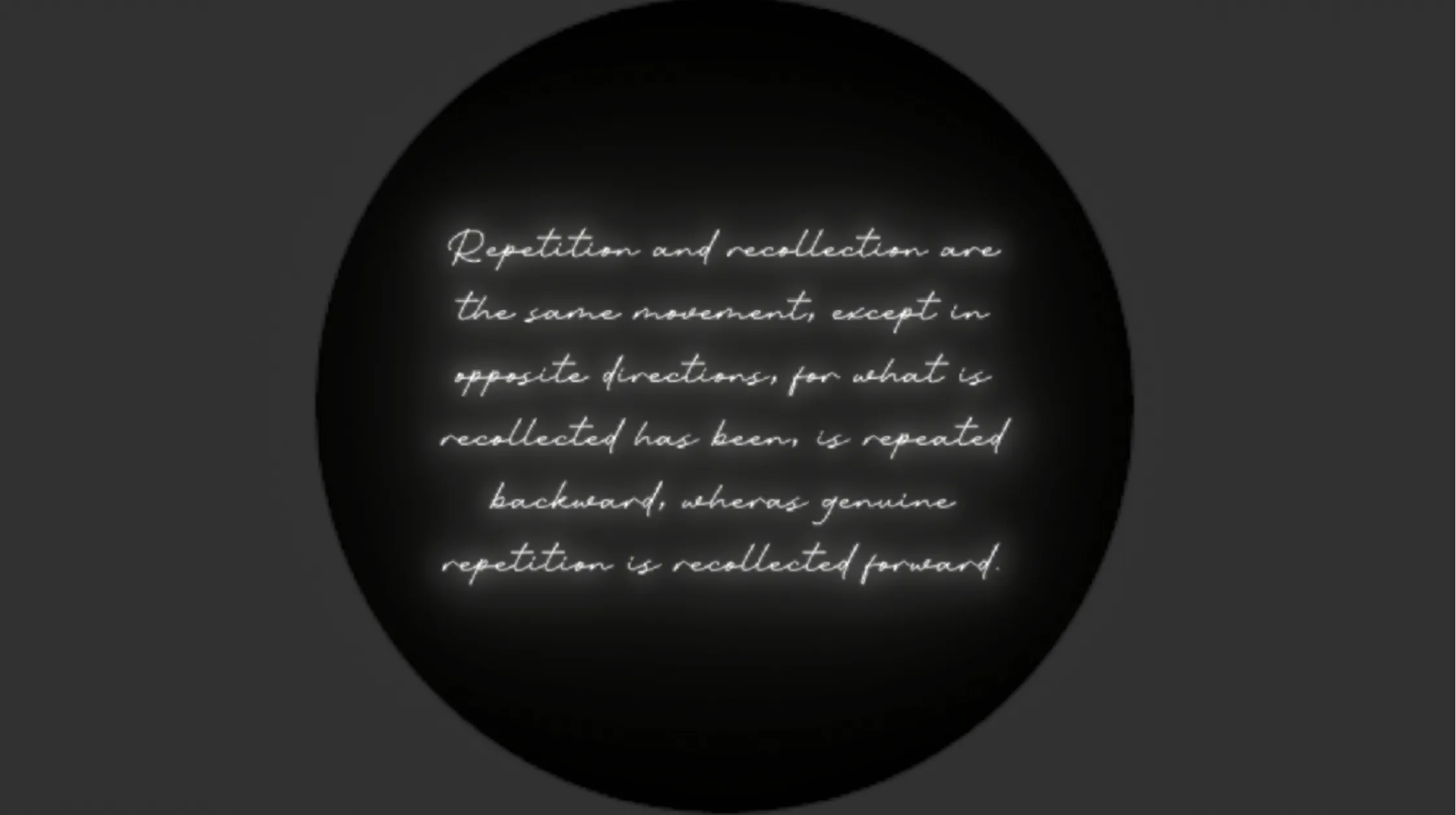
a minimal, contemplative, alt.ctrl game where players use a hand-made, synth-like controller to find the correct locations for on-screen pixels. Subtle visual and sonic cues help to guide the player. As these pixels are moved to their correct locations, they create unique constellations. The creation of these constellations resolves obfuscated abstract content on the screen, revealing texts from Søren Kierkegaard’s essay Repetition. Once the image is fully uncovered, the player is given the opportunity to read the text before the whole image shrinks back down to the single white dot, offering them the opportunity to undergo the activity again. Through this repetitive act of finding, listening, observing, and reflecting, the player is invited into a more contemplative form of play, a play that is guided by them, where there is no discrete ending or win-state 9.
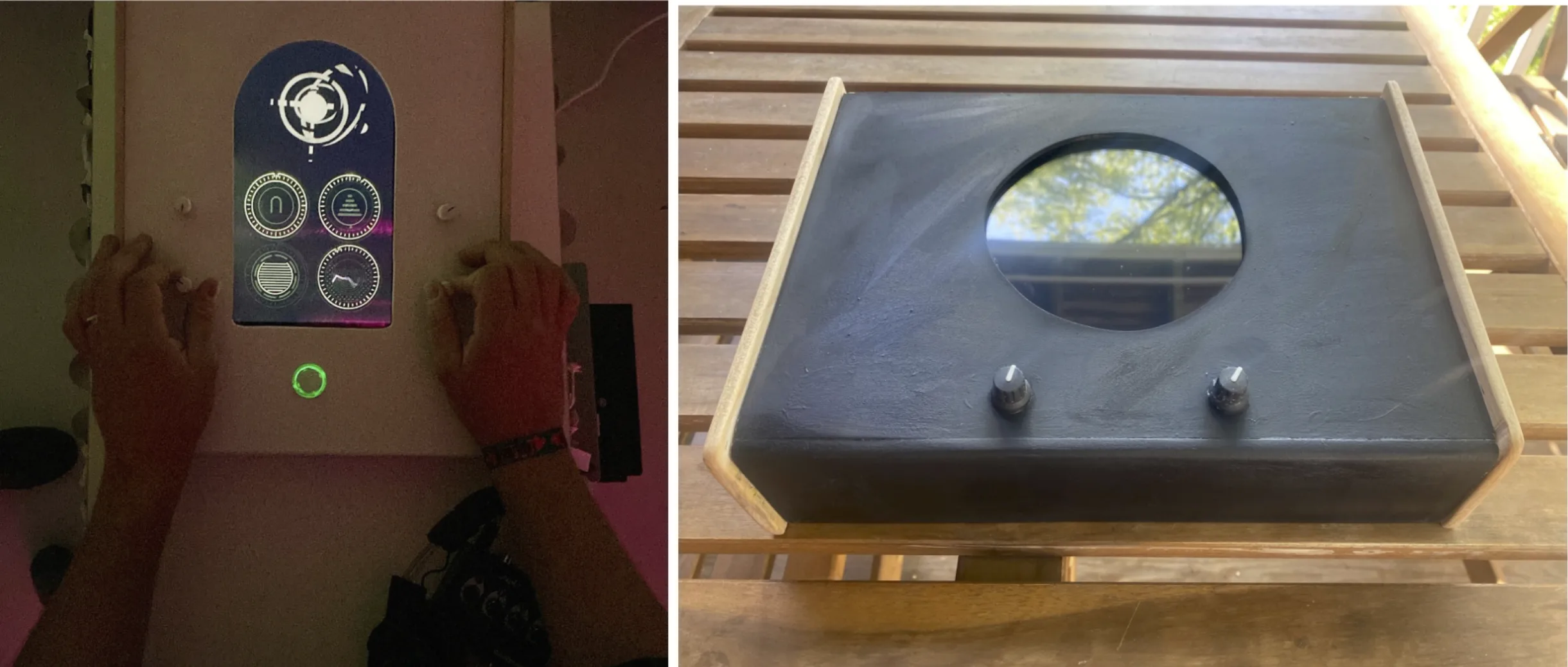
The physical form factors of IE put it in conversation with LTHC, as both appear to use highly similar external casings and input devices. The design rhetorics of IE are related to those of LTHC, though on a reduced scope, prompting a more tightly focused design experience:
- Traditional synthesizer hardware components can be used to control different forms of “playing”.
- Paying attention to relationships between visual and sound cues reveals the functioning of underlying logics.
- Degree of clarity in visual or sound output correlates to degree of correctness of action.
The design goals for IE based on its play experience and public facing media seem to concern the following:
- To support interactions that evoke ritual and invite contemplation.
- To steer players towards attending to their own processes of sense-making through changes in simple abstract imagery and ambient audio.
- To deploy sonic and visual clarity as feedback mechanisms informing players about “more correct” and “less correct” paths of action.
The MDM archives for these projects enable us to explore the relationship between them more deeply than what is possible via examination and engagement with their final artifacts alone. The archives show that IE was borne out of reflections and learnings triggered by LTHC. While IE is not obviously LTHC 2, it explores and occupies sufficient common ground with LTHC that it would be difficult to argue that they are not related. In which case, how should we characterize these projects in relation to one another?
We argue that they are sibling iterations to one another, both of which build on a higher order design conceptual substrate. In a design context, iteration usually refers to a cycle of conceptualization and making directly building on materials and insights obtained from an earlier cycle of the same project, where consecutive cycles are motivated by shared underlying design concerns 10. We add further nuance to how iterative relationships can be characterized in the context of design by proposing that they can be understood as parent-child relationships (i.e. directly building on each other and sharing the same set of design concerns) or as sibling relationships (i.e. not directly building on each other but sharing common material, common processes and practices, and common design ideologies). By identifying resemblances between sibling iterations in the form of common design values, reuse of design techniques, and a continuous approach to design reasoning spanning shared memory – made possible because of the designer’s MDM archives – we gesture towards the presence of an underlying, higher order design substrate.
Sibling Iteration Resemblances
Common Design Values
Hidden (information / mode)
The archives of LTHC 2 and IE 3 reveal that they share common design values, including the discovery of hidden information.
For LTHC, while its archive articulates an early design intention of the presence of multiple “discoverable states, instead of one ‘right’ state,” 11 over time the designer settles on a more specific design intention of uncovering hidden content:
Over the weekend a new (old) idea presented itself: the concept of a secret world hidden within an otherwise confusing-yet-seemingly-traditional-interface. If we lean more heavily on the first part of the interaction as ‘traditional’ synthesis manipulation, then the switch to the second part can be more rewarding 12.
The intended design experience of uncovering hidden information became a core design goal for LTHC, with the second distinct play “mode” (as described above) intentionally completely obscured from the player at the outset of gameplay. The designer’s interest in bimodal gameplay culminated in a 2024 XOXO festival talk about LTHC titled Secrets, and drew connections to the secret areas and Easter eggs of classic games from the 1980s and 1990s, as well as more modern examples, such as Frog Fractions 13.
The IE project, although initially conceived as a more traditional puzzle game, also centres on hidden information. Indeed, the core game mechanic of reliance on sensory clues to “locate hidden locations and lock them in” 14 is standard for hidden-object puzzle games. But extending traditional hidden object game mechanics, like LTHC, IE relies on a bimodal form of gameplay. Its core mechanic requires auditory cues to be paired with visual cues to reveal node locations. Once all node locations have been uncovered, hidden information in the form of texts are revealed.
Minimalism
The archives of both projects reveal the designer’s pursuit of minimalism as a design value, perhaps stemming from a broader consideration of conditions that invite reflective or contemplative experiences in games – subject matter of the designer’s research.
The LTHC design journal declares a design goal of “elegant simplicity - in the physical object, visual representation, and music” 11. This core value proves to be useful for navigating design decisions early on in the ideation process, when the designer is at a crossroads with regards to the visual identity of the project:
My second major idea hurdle here is what will the visuals look like. I really want this to be a robust simulation-type thing [...], but while ideating it becomes clear that there is just too much complexity to deal with here. Also, it somewhat goes against the design value of simplicity, which is important 11.
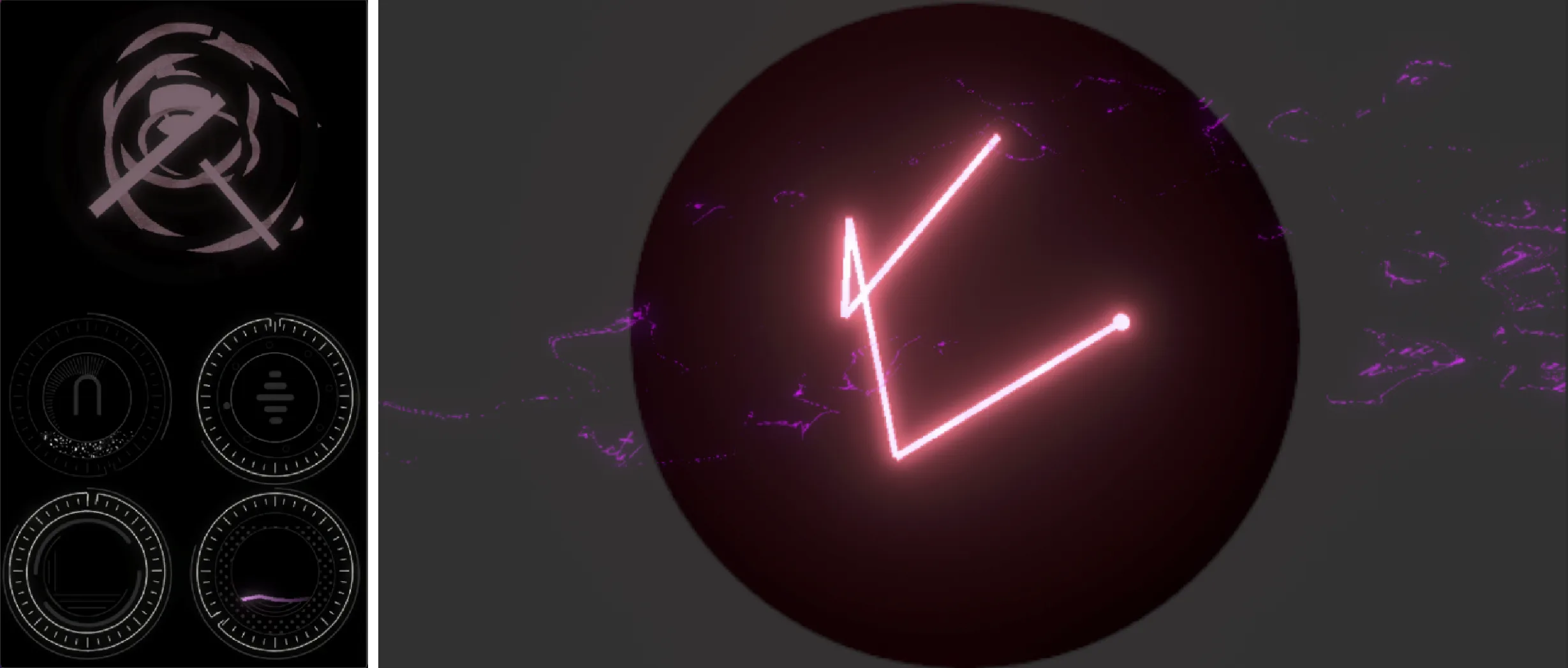
The IE project, meanwhile, is declared from the outset as “an experiment to make a simpler version of Lest Ten Horizons Cry” 14. As stated earlier, the final reflection in the LTHC journal articulates the designer’s desire to revisit LTHC’s themes in a future project that keeps “poking at the question of granular audio control, reflective experiences, and abstract ‘puzzly’ bits” 6. By examining the documentation of IE, we can see that it takes LTHC’s minimalist ideals as a point of departure and continues to streamline and simplify them. This is evidenced in IE’s overall interface (fig. 6), its gameplay loop, as well as its software and hardware elements (which we further detail below).
Ambiguity
Both projects make use of ambiguous input-output pairings that are not immediately discernible to the player. Worth noting is that the initial stated project goals of LTHC do not identify ambiguity as a design experience. The first line of the process documentation states solely,
The initial idea here is alt-control audio-based gamelike interaction. Specifically, what would a game controlled with a synthesizer look like? 5
Ambiguity as a means of structuring puzzle design for LTHC instead emerges later during the conceptualization stage. As a second journal entry authored one week later states:
I like the ambiguity here, especially with the idea of letting the system decide where these "desirable states" should be. (. . . ) Feels like an interesting place to be, as far as causing the player to reflect. The textual output itself could enforce this 11.
The aforementioned proposal of how to invite player reflection (i.e. with textual output) is prescient of IE’s experience. The final interaction of IE leans on this textual element both for meaning and for rewarding the otherwise ambiguous node discovery challenge demanded of the player:
I like the idea of the node-discovery also uncovering some sort of visual element (leaning more into the puzzly parts of this), and after thinking about what this could be, I settled on written text. [..] Once all the nodes are found, the constellation will fade out, leaving the text for a given amount of time, before it collapses in on itself, becoming the starting node for the next "puzzle." And these just keep going and going. Repetition. Some users might walk away after working out one of these, but the hope would be that these function almost more like a labyrinth, where traversing the space in a semi-prescribed way leads to a contemplative state 15.
Adding additional substance to our proposed concept of sibling iterations is a telling line from LTHC’s process journal, placing it within an even longer lineage stretching back to a project called TIKATMOS undertaken by the designer two years earlier 16:
The solution for TIKATMOS, where the system randomly chose values that the user is trying to locate, is a good place to start. However, there should be some slight increase in complexity and beauty. "A better implementation of the TIKATMOS tuner minigame" still stands 11.
TIKATMOS was a voice-controlled alt.ctrl game (developed in collaboration with the Whaaat!? Lab of the ATLAS Institute at the University of Colorado, Boulder) that won the Live Action Award at the 2022 IndieCade Festival. Worth noting is that it was only in authoring this paper that the designer became properly cognizant of the common design experience threads linking IE, LTHC, and TIKATMOS.
Common Design Techniques
Hardware
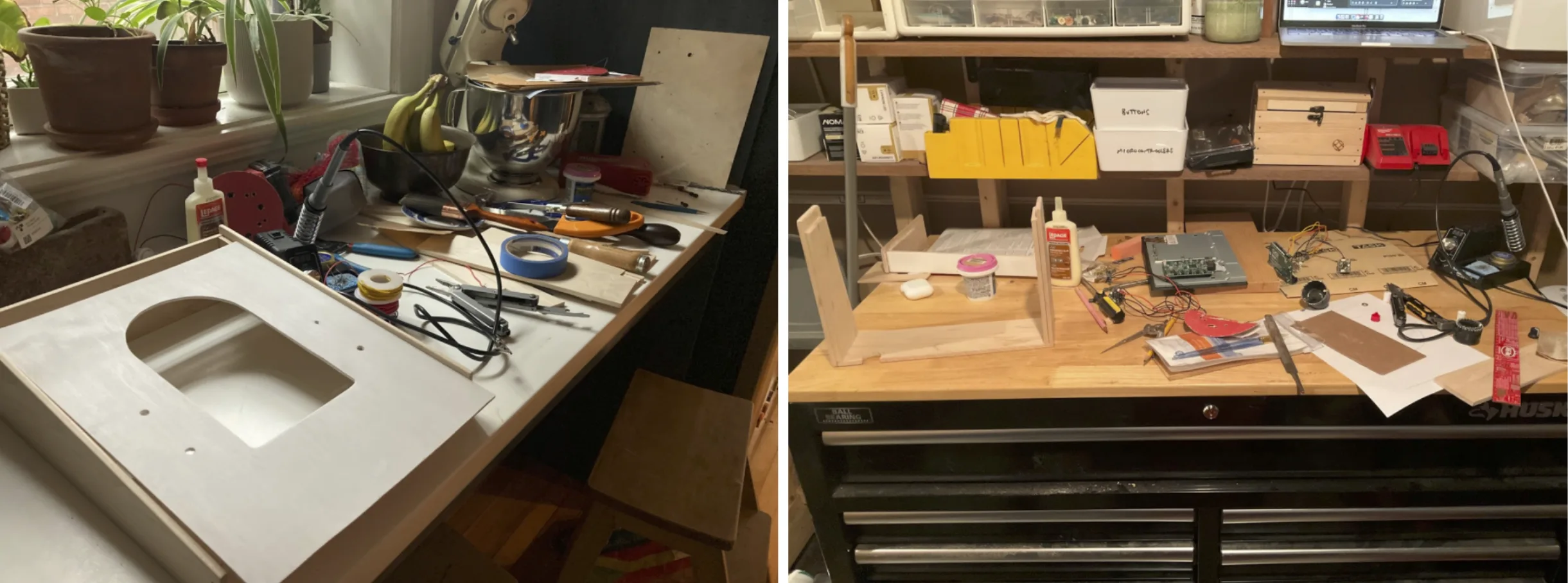
An outsider to the design processes of LTHC and IE would be able to glean a relationship between both projects for a simple reason: they literally share each other’s physical materials. Components from LTHC were repurposed to create IE, meaning that LTHC no longer exists in physical form. LTHC’s dials, screen, microprocessor, and external monitor were all recycled in order to physically realize IE. Likewise, the handmade wooden box enclosure for LTHC was deconstructed, cut down, and repurposed to house IE. The designer sacrificed the physical materials of LTHC to bring IE to life, even if he did not use the materials to identical effect in IE.
LTHC’s archive contains numerous journal entries dedicated to explaining, complaining about, and documenting the various issues that arose during the construction of the project, such as the following excerpt:
I always seem to forget how un-friendly all of these electronic components are with each other, and how annoying it can be to get everyone playing nicely. [...] Even with the large number of technically similar projects that I’ve made, these issues still arise. There are unexpected failures. The pieces don’t always fit. And it seems like this is more the rule than the exception 5.
In contrast, the IE archive is notably absent of experiences like the LTHC entry above. This suggests one of two major possibilities: either the designer chose to stop being bothered by hardware hurdles (less likely), or was no longer bothered by them because they were no longer hurdles (more likely). If the latter, the hardware problems presented by LTHC and IE were similar enough that the knowledge gleaned from LTHC was transferable to IE, and the designer’s attention was freed up to focus on higher-level design goals. We additionally point out that an absence of technical hurdle mentions from the IE archive is only possible to notice because they were centrally present in the earlier LTHC archive occupying similar design territory, i.e. our observation arises by reasoning about materials across multiple archives from the same maker.
The shared physical material lineage between LTHC and IE is of particular note in the context of practices commonly deployed by boutique hardware and alt.ctrl design communities. Games scholar Enric Llagostera notes that research on the projects developed by these communities is significantly complicated by how such projects rely on specific enough hardware and software arrangements that they are experienced in their intended form only within tightly controlled space and time frames 17. Even games showcased at large game conventions such as alt.ctrl.GDC are only played by a few people. Due to the physical size, spatial storage requirements, and specialized controls of alt.ctrl games, after they have been showcased, they are often deconstructed and mined for parts that are reused in future projects. We point out that MDM archiving significantly extends the material life of alt.ctrl games, through the transmediated material traces that MDM documentation entails. Someone who is unable to attend a games conference featuring alt.ctrl works may still benefit from the design learning and reasoning experienced by alt.ctrl game designers if those designers have committed to documenting their design reasoning using MDM.
Software
Several LTHC archive journal entries detail the issues the designer faced when initially prototyping its software, including how to make the various third-party pieces of the interaction communicate with each other. The designer had to develop a specific process for turning RNBO patches into usable Unity instruments using a third-party tool for LTHC. Beyond this, the designer also had to learn how to navigate the use of multiple cameras, serial routing, I2C addressing, and other issues specific to his workflow. With much of the designer’s attention and energy consumed by mastery of technical challenges, there were simply fewer cycles remaining for addressing LTHC’s expressive qualities and experience. This is voiced by the designer in the LTHC reflective journal as frustration at how much cognitive real estate has been occupied by software integration problem solving:
I don’t even want to get into all the ups and downs (and smashing my head on the table) it took to get this set up, but I will because it’s all part of the job 18.
Just as repurposing the hardware of LTHC pushes IE forward, the ready reuse of software plays into the eventual success of the IE project. Comparing the two project repositories, we see that many of the software solutions from LTHC reappear in IE. First, the Arduino code that the controller uses to send information to the Unity build is unchanged (fig. 9). As mentioned above, the same microcontroller is used for both projects, and the code written to handle the dial movement is untouched. Similarly, the Controller script, written for Unity to parse the incoming serial data from the controller, is reused with minimal changes 19. Additionally, although the two projects have very different on-screen visual styles, they both utilize the third-party Limitless Glitch Effects plugin for handling glitch effects 20. Likewise, RNBO 21, a special version of the software Max, has been used to create instruments for both projects. In fact, the IE synthesizer is a direct iteration on the LTHC synthesizer: other than a series of simplifications, it is primarily the same instrument (cf.1922).
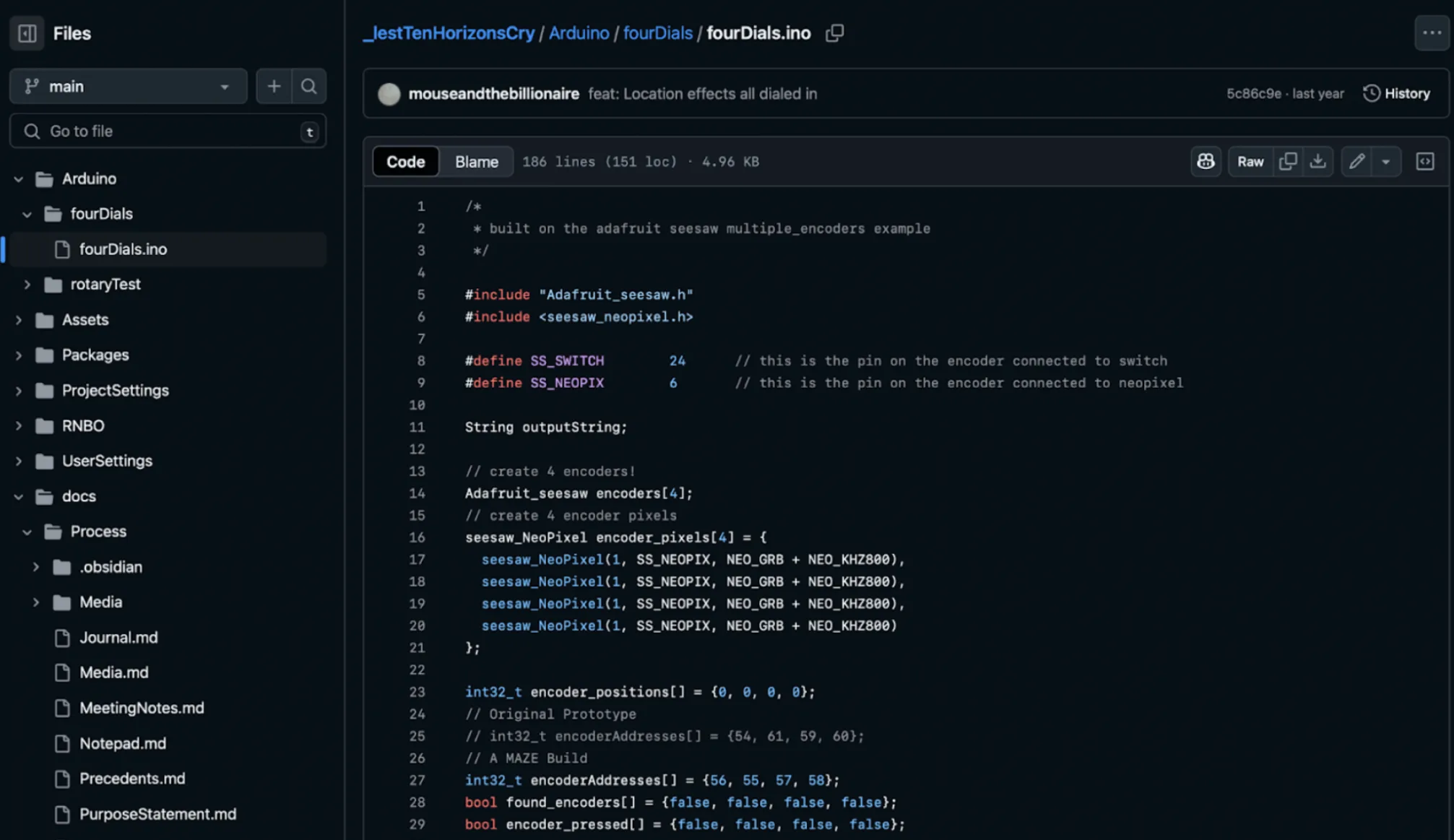
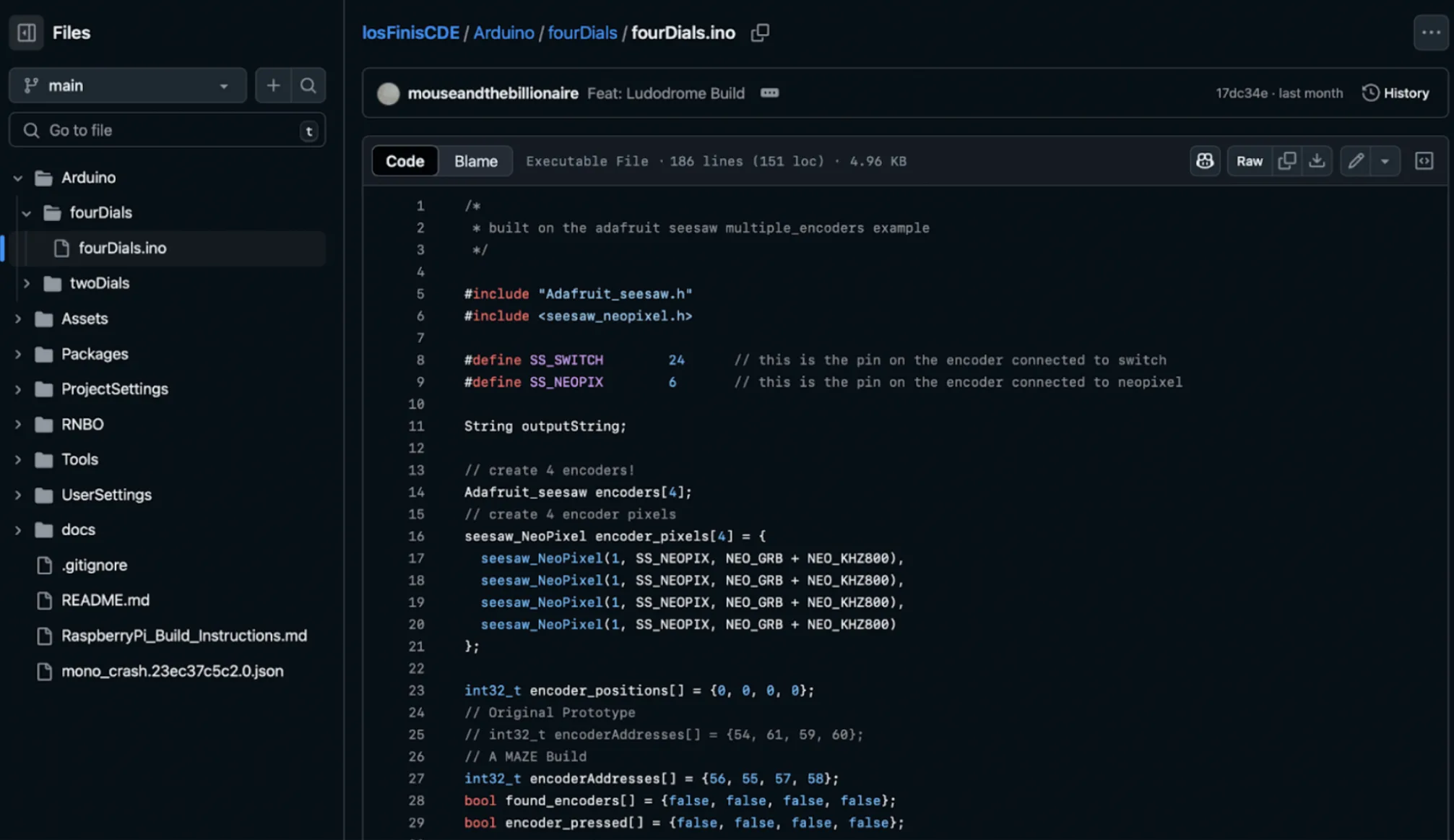
The reflective journal for IE suggests that software concerns played a far less central role in comparison to LTHC. Mirroring our earlier observation of absence of mention of hardware hurdles, in the IE journal software concerns are also absent of mention. The archive for IE also verifies that the software for dial interaction, communication between the controller and Unity, and the implementation of RNBO instruments for Unity is ready and available for application in the new context from early on in the lifespan of IE 22. The designer was therefore able to easily use the newly created medium (controller + external screen + specialized software synth + Unity) to explore his original design goal of finding secret locations with a minimal interface. Not only did this speed up development time, it afforded an environment in which the designer could return to the core experience design values of the project: why explorations as opposed to how ones. Why explorations cannot be addressed without addressing how explorations when bespoke technical infrastructure is in play – like the relationship between comprehension and reading. Time spent earlier with LTHC navigating technical infrastructure was recouped in IE, enabling the designer to turn his attention to honing the designed experience into the desired experience.
The Spectral Parent (of sibling iterations)
Both of these projects share too much in common to be unrelated. They have significantly overlapping design values. They make use of the same bundlings of technical infrastructure. The transferability of knowledge between LTHC and IE further gestures to their similarity as design problems.
Yet they are also distinctively different from one another. The earlier project archive focuses a lot on technical difficulties, the later project archive does not. The earlier project was an attempt to do more, the later project was an attempt to do less. The earlier project did not land its experience design goals entirely successfully, the later project did.
The fact that the designer made a project so similar to an earlier one suggests there was some kind of drive to revisit something. But the later project is not an iteration to the earlier one. We assert that both projects were iterations to the same thing: a spectral parent design concept. Both projects looped off of a single implied – and unmaterialized – parent concept. This would explain why throughout their making trajectories both projects occupied sufficiently similar design solution spaces: iterations are co-located with their predecessors. The lack of mention of hardware and software concerns for IE also suggests that engagement with technical questions was not of primordial importance to the designer: those questions remained interesting only insofar as they facilitated exploration of a certain form of tangible experience design. The designer being satisfied by the end of the IE project that his design goals had been met also speaks to a curiosity being sated; a question having been properly answered.
From the archives of LTHC and IE, we see that the designer privileged an approach of “paring back” both concept scope and materials in IE as a way to hone in on the desired design experience, akin to the process of editing film or engaging in the process of sculpture. The successful combination of materials and mechanics – as landed on during the IE design process – was present in the LTHC iteration, if obscured by additional elements of designed experience. The designer was even aware, at some level, that this was the case: perceiving the distance between the spectral parent design concept and LTHC’s experience, he pursued a design problem solving strategy of “less is more (like the parent design concept)” to lessen the gap between the spectral parent design concept and sibling IE’s experience.
Footnotes
-
Richard Buchanan. 1985. Declaration by Design: Rhetoric, Argument, and Demonstration in Design Practice. Design Issues 2, 1 (1985), 4. doi:10.2307/1511524 ↩
-
Matthew Bethancourt. 2023. mouseandthebillionaire/_lestTenHorizonsCry ↩ ↩2
-
Matthew Bethancourt. 2025. GitHub - mouseandthebillionaire/losFinisCDE. ↩ ↩2
-
Mouse & the Billionaire. 2024. Mouse & the Billionaire: Lest Ten Horizons Cry. https://mouseandthebillionaire.com/lthc/ ↩ ↩2
-
Matthew Bethancourt. 2023. Context Statement | 09.01.23. ↩ ↩2 ↩3
-
Matthew Bethancourt. 2024. A MAZE. Berlin | 05.13.24 ↩ ↩2
-
LUDODROME. 2025. LUDODROME 2025. https://www.instagram.com/ludodrome/ ↩
-
Matthew Bethancourt. 2025. losFinisCDE/README.md. ↩
-
Mouse & the Billionaire. 2025. Instauratio Exiguus. https://www.mouseandthebillionaire.com/ie/ ↩
-
John Sharp, Colleen Macklin, Steven Davis, Yu Jen Chen, Tuba Ozkan, and Carla Molins Pitarch. 2019. Iterate: Ten Lessons in Design and Failure. The MIT Press. doi:10.7551/mitpress/10826.001.0001 ↩
-
Matthew Bethancourt. 2023. ideation | 09.08.23. ↩ ↩2 ↩3 ↩4 ↩5
-
Matthew Bethancourt. 2024. New Adventures in UI | 01.10.24. ↩
-
Inc. Twinbeard. 2020. Frog Fractions. https://store.steampowered.com/app/ 1194840/Frog_Fractions_Game_of_the_Decade_Edition/ ↩
-
Matthew Bethancourt. 2025. 03.01.2025. ↩ ↩2
-
Matthew Bethancourt. 2025. 04.26.2025 / Busy Week! ↩
-
Mouse & the Billionaire. 2022. TIKATMOS. https://mouseandthebillionaire.com/tikatmos/ ↩
-
Enric Granzotto Llagostera. 2024. On Critical Controllers: Exploring Reflective Game Design Through Altctrl Devices, Games, and Practices. https://core.ac.uk/outputs/636728443/?source=2 ↩
-
Matthew Bethancourt. 2023. RNBO Setup | 10.05.23. ↩
-
Matthew Bethancourt. 2024. _lestTenHorizonsCry/Assets/Scripts/Controller.cs. ↩ ↩2
-
Limitless Development. 2021. Limitless Glitch Effects Asset Pack. https://limitless-development.itch.io/limitless-glitch ↩
-
Cycling 74. n.d.. RNBO. https://cycling74.com/products/rnbo ↩
-
Matthew Bethancourt. 2025. feat: so much work. ↩ ↩2