Generative Logics and Conceptual Clicks
By Rilla Khaled
Re: It is as if you were making loveJanuary 1, 2023
We share key GDT findings from Love’s archive to demonstrate the possibilities of MDM and to articulate design knowledge specific to Love and Barr’s design practice.
Wayfinding Through Questions
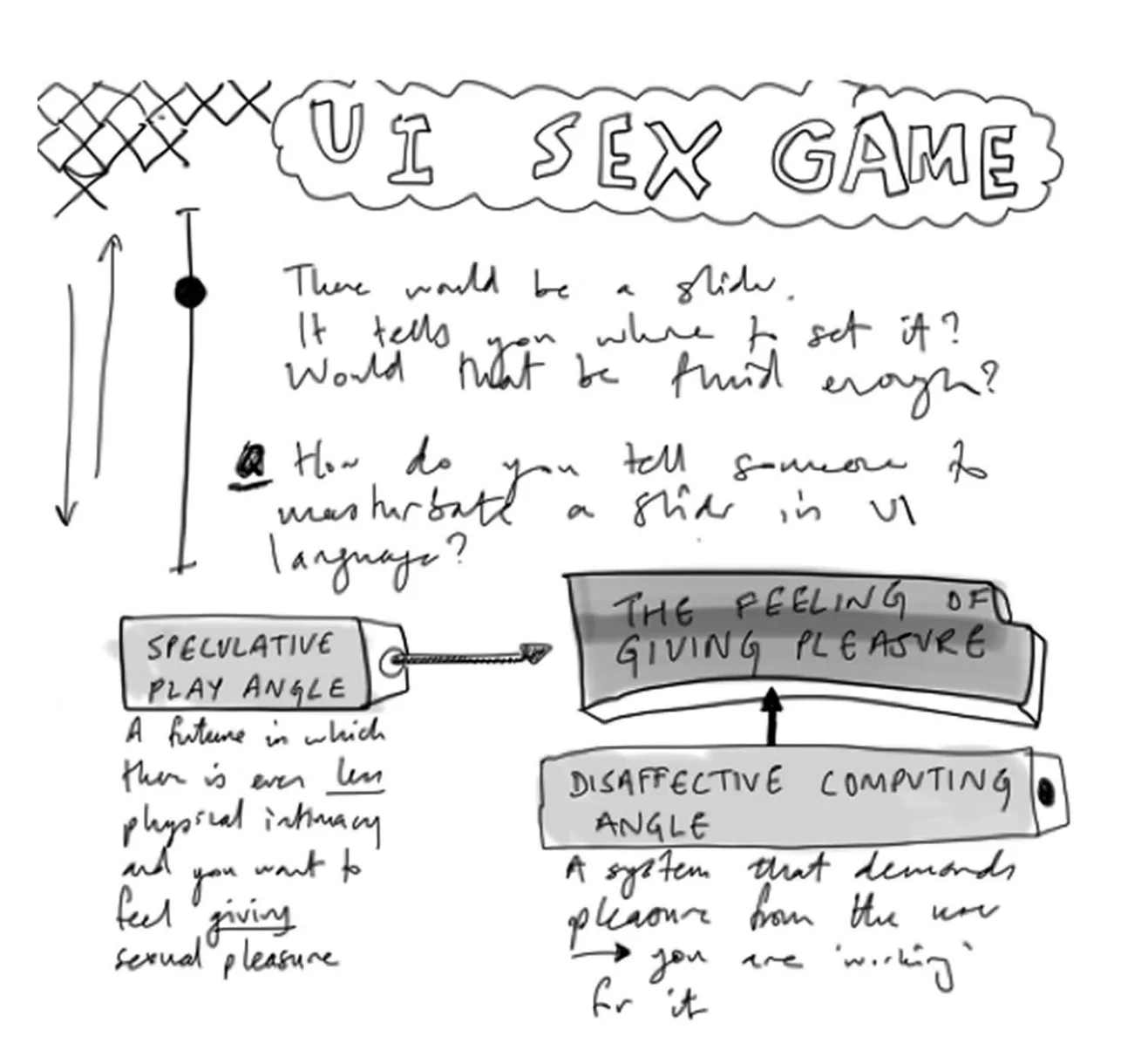
Design must start somewhere but settling on an overarching design question is nontrivial. Schön refers to this stage as problem framing (i.e., identifying the problem space), noting that this starting point necessarily has lasting effects on how the problem can be solved. [40] When Barr began work on Love, his design journal entries showed evidence of locating a starting point, of planting a flag that says, “start here.” As Figure 3 shows, the nature of the design questions and visions proposed are expansive, high level, and open: Barr was still relatively unfamiliar with the design terrain being traversed.
As work on the project progressed, the questions Barr asked himself were increasingly specific. In a commit message accompanying a game build one week later, Barr commented [41]:
I do need to make sure I have a way of making the interaction actually feel like something. It still feels a little frictionless and a little undirected. It would make sense for the interface to have desires that can be communicated, rather than be a black box? In which case literal instructions? “Slide me between 3 and 5”?
Because MDM requires every build to be paired with a commit message, the relationship between design prototypes and the design hypotheses they embody is demystified. From this commit, we know that Barr has a prototype that implements an interaction, but the prototype does not yet convey the right feeling. Research on how designers use prototypes acknowledges that prototypes are experiments, materializations of design hypotheses that essentially always ask (alongside other potential questions) “is this going in the ‘right’ direction?” [42] The answer from Barr’s writing seems to be “not quite, not yet.” Indeed, one week later, Barr is still grappling with how to design his interface such that interacting with user interface (UI) elements feels like giving sexual pleasure[43][44]:
What can the player do with the slider and how can that be detected and transformed into information that I can interpret?
Could you ask them to just brush the mouse over the slider without sliding? Over the handle? Or is that sufficiently foreign that it doesn’t make sense (and also doesn’t work with mobile).
Deeper into the project, earlier questions start to be resolved, while new questions become ever more specific. The following is an excerpt from a commit message[45]:
Now have stroke ranges and numbers set up with arrays so that it’s easier to tune to specific stroke formats and numbers, it works well I think and makes more sense in terms of being able to control the experience the player’s having—there are particular kinds of strokes that are sexier, I think, than others (e.g., 0 to 10 is hotter than 1 to 7, say). I mean, this is getting pretty weird, but I think it’s true.
By now Barr has successfully answered his earlier question of how to design his interface such that interacting with UI elements feels like giving sexual pleasure, and is instead focusing on the more fine-grained issue: which kinds of UI interactions feel sexier? Abstract depictions of design often depict it as a funnel lying horizontally: at the start of design, questions, concerns, and solutions are explored broadly, erratically, and divergently, whereas toward the end of design, a tighter, directed, and convergent approach is used.[46] MDM equips us with the means to precisely engage with how wayfinding happens through design spaces and elucidates how design questions, concerns, and solutions become increasingly specified across a project’s lifetime.
Bidirectional Framing
When Barr initially began work on Love, he posed questions about UI sliders and masturbation, as can be seen in Figure 2. It becomes clear that these stand in for two broader concept systems: UI interactions and sexual pleasure respectively, for example, “Caress my dates,” “Tickle my weekends,” and “Touch my Mondays.” [47]
From the first to the last day of work on the project, Barr endeavored to understand each concept in terms of the other. That is, he looked for how sexual pleasure can be framed as UI interactions: “the game can certainly make it fairly easy/straightforward/ non-oblique as to how to give pleasure (set me to 2, set me to 4 set me to 2 set me to 4...).”[48] Likewise, he looks for how UI interactions can be framed as sexual pleasure: “what becomes more important, maybe, is the reaction of the interface . . . proving that you are, indeed, successfully pleasuring it (through dialogs, sounds, perhaps other visual effects).”[49] A straightforward interpretation of Barr’s process here might be to consider UI interactions as a metaphor for sexual pleasure. Indeed, more generally oriented and academic game design writing both identify finding playable metaphors as a common design approach for games that seek to express familiar qualities of our lived experiences.[50] We propose that a different dynamic is at work in Barr’s process: bidirectional framing. Whereas metaphors concern unpacking how a metaphor’s subject is like its vehicle, bidirectional framing concerns unpacking two distinct phenomena in terms of each other, progressively closing in on understandings of each phenomenon that mutually reinforce each other. In Playing with Feelings, Aubrey Anable provides an account of touch-focused play experiences that mirror the design dynamic of bidirectionality: “We are accessing through touch how the game’s algorithms work, and we are learning to manipulate the algorithms according to our desire for a certain outcome . . . . At the screen, we touch the game and the game touches us.”[51]
Anable posits that a procedural, rule-based view of games will only explain part of their affective experience. Returning to the designerly standpoint, Barr proceeds with design reasoning by using a bidirectional lens. The UI interfaces he codes and develops over the course of the project are significantly influenced by affordances for expressing sexual pleasure, while the type of sexual pleasure focused on is that which resonates with the affordances of UI interfaces. Barr uses bidirectional framing throughout the design process at ever finer granularities to rescope and refocus his design questions [52]:
Game over is now an “arousal overflow” which I find pleasing. It’s an ending dialog based around a screenshot I found of a Windows-based buffer overrun error. It works nicely as a deadpan ending, with the app itself still orgasming all over the place in the background. When you dismiss the message, the whole thing shuts down. I actually only did it this way in order to be able to turn the sounds off! But it works well.
Barr’s use of traditional UI elements as a way to perceive and receive sexual pleasure resonates with Pozo’s positioning of haptic visuality—productive troubling of the distance between haptic experience and meaning—an approach that Pozo notes is frequently used in queer games that explore love.[53]
One of the final changes Barr makes to Love concerns reorienting the slider from vertical to horizontal [54]:
I’m in conversation with Jim and Mary (my parents) about the gendered nature of the vertical slider. Had the important experience of Mary pointing out that sliding the vertical slider has different connotations for her as a woman . . . if I want it to feel like “pleasuring a computer because pleasuring other people (or things?) is a pleasure” then it needs particular kinds of inflections. If it feels like a chore, or a gross patriarchal or gender normative thing, then it’s going to lose that sense.
Bidirectional framing is especially evident here: by now Barr was explicitly working not to represent normative, male-oriented sex. Indeed, we find in his design journal many hundreds of words diving deep into questions of eroticism, qualities of interaction, and moving beyond anatomy.[55] Instead, he is camped out in the resonant middle ground between UI interfaces and sexual pleasure, between queering interfaces and queering sex.
Generative Logics and Conceptual Clicks
Partway through the design process, Barr admits to feeling stuck: “Whenever I return to this project I feel deeply uninspired by it . . . something it [sic] wrong with it. What is wrong with it?”[56] Barr identifies roots of the problem as well as a potential solution [57)]:
I wonder if it’s actually just too clean looking? Is this a situation where I need to reference another style again? Should I be returning to the idea of the Win95 styling of It is as if you were doing work? It makes them a nice pairing for one thing, feels more dehumanising but with a lighter touch than total minimalism. There’s no reason for this thing to look “stylish” . . . perhaps that’s the issue . . . it needs to say “user interface” not actually be a slick user interface.
In a journal entry from the next day, Barr is increasingly convinced that the potential solution is promising for reasons beyond aesthetics [58]:
I’m trying to give myself permission to massively simplify the way I’m thinking about this game. I think the shift to the Windows 95-esque aesthetic helps with that (it doesn’t look particularly capable of complexity or subtlety). I think I need to radically simplify how pleasure works . . .
Two days later, Barr verifies that shifting to Windows 95 styling has changed his perception of the design problem [59]:
I changed over the style file and also redid the styling of the pips to look more Windows-y. At that point it also somehow seemed to make more sense to have the slider click to different settings rather than slide smoothly among them, so I also reinstated that (default) behaviour. So it’s quite a different slider at this point, feels different, looks different.
While he initially characterizes the shift to a Windows 95 styling as aesthetic, Windows 95—along with its associated design tropes, interactions, and functionality—becomes a generative logic for the project. Identifying this specific generative logic eases the task of determining and justifying future design moves in ways that reinforce internal consistency with other design moves: “This kind of interface feels like it would be much more direct and obvious about registering how the sex is going—it would just tell you.”[60] This generative logic is demonstrably effective through the sheer density of successful design moves it gives rise to, which we refer to as conceptual clicks. A recognizable feature of a conceptual click is that the designer understands when they are experiencing them; resulting design moves flow (relatively) freely and internally consistently, and they satisfy the designer’s internal compass for whether they are headed in an appropriate direction. The following passage illustrates Barr having a conceptual click concerning slider feedback after adopting Windows 95 as a generative logic [61]:
I’d been assuming the slider would express its pleasure via more anthropomorphic things like vibration, pulsation, etc. But with the windows95 version it’s much less clear that makes sense... I’m suddenly more inclined toward other forms: a progress bar that could show current intensity of pleasure? Or “progress to organism”? (Completion. The happy ending.) Other read-outs? Sounds might need to again draw from the windows system sound set? How can they then be made sexy? Repetition, out of control at the end. Still like the idea of breathing in there somehow... Okay well it seems kind of like this is going to make my job easier?
Further evidence of conceptual clicks linked to the generative logic accompany the build that introduces a Windows 95 progress bar [62]:
Added a progress bar officially and again styled it as per win95 (they have a white background, garishly). The progress bar is kind of a nice symbol of the simplification of this game, moving away from ambiguity and the sexiness of not knowing to certainty and the sexiness of knowing. Makes my life easier and it’s good to have that symbolised right there in the UI in case I forget!
On adoption, an effective generative logic will engender a density of conceptual clicks, as in this case. By contrast, we conjecture that an ineffective generative logic will invite far fewer conceptual clicks, either because it lacks generative potential or because it is a poor fit to the design problem.
Incidentally, Barr’s generative logic bears a family resemblance to one used by Naomi Clark in her card game about sex and consent, Consentacle [63] In her interview in Bonnie Ruberg’s collection The Queer Games Avant-Garde, Clark recounts: “When I was playtesting Consentacle, I saw these moments of friction where people were like, ‘Wait, why am I thinking about tokens when what I want to be doing is having sex? That’s so weird.’ I thought, ‘Yes, perfect! There’s something here that’s wrong in just the right way.’”[64]
Humor as a Critical Lens
As expressed in one of Barr’s quotes, he has used Windows 95 as a generative logic before: in the predecessor sibling game to this one, It Is As If You Were Doing Work (Work).[65] For Barr, Windows 95 is inexorably linked to a particular feeling: it is slightly clumsy, its elements too big and aged in a way that does not flatter computational technology; it is funny. Like Love, Work can be characterized as critical/speculative design. For Barr, humor is an essential part of the critical designer’s repertoire. He reflects on Work in the context of the current game: “In that game, too, I started with a slick and futuristic UI only to realise that it was holding me back from the comic element that (I think) good critical design needs.”[66] As Auger points out about speculative design, humor is an especially rich perspective to draw on as it is often premised on surprise, which can only be generated when we have an expectation that events will unfold differently. [67] Critical and speculative design must evoke a slight familiarity to have rhetorical power. Windows 95 as a generative logic succeeds in engaging Barr in a critical design mode, as it gives him permission to embrace humor and look for what is funny, familiar, and unsettling about the design research questions. On listening to sound packs from earlier editions of Windows for inspiring the game’s sound design, Barr says: “I really do like the fact of them being these awkward corporate sounds to be incorporated into this sex game... The logoff sound is pretty funny for when the window closes post orgasm.”[68] Because Barr has used Windows 95 as a generative logic before, it constitutes tacit knowledge for him, that is, knowledge developed via previous practice. Schön argues that one difficulty of capturing how professionals work is their reliance on tacit knowledge to solve current problems, because tacit knowledge itself is hard to annotate.[69] The MDM gives us an infrastructure for annotating tacit knowledge and examining its reach, as we can see in comparing our GDT analysis of Work [70] with the current case study.
References
[40] Donald A. Schön, “Problems, Frames and Perspectives on Designing,” Design Studies 5, no. 3 (July 1984): 132–36, https://doi.org/10.1016/0142-694X(84)90002-4.
[41] Pippin Barr, commit message, commit db90b59e, GitHub, April 2, 2018, https://github.com/pippinbarr/itisasifyouweremakinglove/commit/db90b59e
[42] Youn-Kyung Lim, Erik Stolterman, and Josh Tenenberg, “The Anatomy of Prototypes: Prototypes as Filters, Prototypes as Manifestations of Design Ideas,” ACM Transactions on Computer-Human Interaction 15, no. 2 (July 2008): 1–27, https://doi.org/10.1145/1375761.1375762.
[43] Pippin Barr, Design Journal, GitHub, April 9, 2018, https://pippinbarr.com/itisasifyouweremakinglove/process/journal.html#2018-04-09-1415-mondayon-cart415-discussion-input-parametersfailure-sepes-cumshot-game-flow
[44] Barr, Design Journal, April 9, 2018.
[45] Pippin Barr, commit message, commit 66f1cc74, GitHub, June 8, 2018, https://github.com/pippinbarr/itisasifyouweremakinglove/commit/66f1cc74.
[46] Bill Buxton, Sketching User Experiences: Getting the Design Right and the Right Design (Amsterdam: Morgan Kaufmann, 2011) https://doi.org/10.1016/B978-0-12-374037-3.X5043-3
[47] Pippin Barr, Design Journal, GitHub, March 24, 2018, https://pippinbarr.com/itisasifyouweremakinglove/process/journal.html#2018-03-30--in-whichsome-more-design-notes-from-the-ipad
[48] Pippin Barr, Design Journal, GitHub, June 4, 2018, https://pippinbarr.com/itisasifyouweremakinglove/process/journal.html#monday-4-june-2018-733am
[49] Barr, Design Journal, June 4, 2018.
[50] Sebastian Möring, “Simulated Metaphors of Love: How The Marriage Applies Metaphors to Simulate a Love Relationship,” in Game Love: Essays on Play and Affection, edited by Jessica Enevold and Esther MacCallumStewart, (Jefferson, NC: McFarland, 2015), 196–215
[51] Aubrey Anable, Playing with Feelings: Video Games and Affect, 67 (Minneapolis, MN: University of Minnesota Press, 2018).
[52] Pippin Barr, commit message, commit 0484e25, GitHub, June 22, 2018, https://github.com/pippinbarr/itisasifyouweremakinglove/commit/0484e25bcd28d9a922c926724189e27588f764f8
[53] Teddy Pozo, “Queer Games After Empathy: Feminism and Haptic Game Design Aesthetics from Consent to Cuteness to the Radically Soft,” Game Studies 18, no. 3 (December 2018), http://gamestudies.org/1803/ articles/pozo.
[54] Pippin Barr, commit message, commit fbc8aa4, GitHub, June 14, 2018, https://github.com/pippinbarr/itisasifyouweremakinglove/commit/fbc8aa486a9c6a1be605ee0bf0cf683a9b6f727a.
[55] Pippin Barr, Design Journal, GitHub, June 15, 2017, https://pippinbarr.com/itisasifyouweremakinglove/process/journal.html#friday-15-june-2018-717am.
[56] Pippin Barr, Design Journal, GitHub, June 3, 2018, https://pippinbarr.com/itisasifyouweremakinglove/process/journal.html#2018-05-03-1452-thursday--honestly-im-going-to-get-back-to-this.
[57] Barr, Design Journal, May 3, 2018
[58] 58 Barr, Design Journal, June 4, 2018.
[59] Pippin Barr, Design Journal, GitHub, June 6, 2018, https://pippinbarr.com/itisasifyouweremakinglove/process/journal.html#2018-05-06-1839-sunday--windows-95.
[60] Pippin Barr, Design Journal, GitHub, June 7, 2018, https://pippinbarr.com/itisasifyouweremakinglove/process/journal.html#thursday-7-june-2018-655am
[61] Barr, Design Journal, June 6, 2018.
[62] Pippin Barr, commit message, commit cedebc40, GitHub, June 6, 2018, https://github.com/pippinbarr/itisasifyouweremakinglove/commit/cedebc40.
[63] Naomi Clark, Consentacle (card game), 2018.
[64] Bonnie Ruberg, “Naomi Clark: Disrupting Norms and Critiquing Systems through ‘Good, Nice Sex with a Tentacle Monster,’” in The Queer Games AvantGarde: How LBGTQ Game Makers Are Reimagining the Medium of Video Games (Durham, NC: Duke University Press, 2020), 102–12.
[65] Pippin Barr, It Is As If You Were Doing Work, browser game (2018), https://pippinbarr.com/itisasifyouweredoingwork/
[66] Barr, Design Journal, June 7, 2018
[67] James Auger, “Speculative Design: Crafting the Speculation,” Digital Creativity 24, no. 1 (March 2013): 11–35, https://doi.org/10.1080/14626268.2013. 767276
[68] Barr, Design Journal, June 6, 2018.
[69] Schön, The Reflective Practitioner
[70] Khaled, Lessard, and Barr, (2018) “Documenting Trajectories in Design Space." https://dl.acm.org/doi/10.1145/3235765.3235767