It is as if you were doing work
By Jonathan Lessard
Re: It is as if you were doing workAugust 7, 2018
Work was released by Pippin Barr in July 2017. It presents itself as an application designed to give a sense of purpose to the idle humans of a near future in which all work has been delegated to robots 1. It takes the form of an early Windows-style desktop environment with modern office-like tasks to be performed through the manipulation of conventional GUI elements, such as sliders, radio buttons, and text boxes (see figure 3). The game was noticed by a number of generalist and specialized publications, most picking up on the game’s social commentary: “A job simulator designed to make you feel useful, chasing your existential anguish. Horrible, isn’t it?” 2, (translated from French).
A U.I. Game
A key finding in looking at the design process of Work is that the post-work satire (arguably the most salient aspect of the released game) is completely absent from the project’s inception. Barr’s first entry states his new project’s basic idea as: “A game made entirely of small (WarioWare-esque) activities from our daily life of using computers. So, for instance, you might be challenged to drag a folder into the trash, or move a slider to a specific setting” 3. This brief statement is already very rich with game designerly thinking. For one, Barr begins from an observation of a human behaviour (here the trivial yet omnipresent use of standardized graphic user interface elements) and asks the question of how this activity could be thought of as a game. This is one of the most basic yet fruitful game design operations: I see that people move toward destinations – what if they were challenged to get somewhere before others? What if they had to jump over small fences in the process? Game designers are always on the lookout for activities that have not yet been appropriated for the realm of games. The proof that this is key to Barr’s thinking about his project is that before he had settled for a title, he often refers to his project as the “UI game”.
Another typical game design approach is to think in terms of other games or game genres to articulate aspects of the project. Games are rarely entirely novel, and the parts that are derived from pre-existing designs can be summarily communicated by referring to examples (especially since game design is still very much in the process of standardizing terms to refer to typical forms). One of the first things Barr says of his project is that it is “WarioWare-esque”, by which he probably wants to evoke a series of mechanically varied, randomly selected mini-challenges prompting players to quickly understand what the actions they need to perform as in the game WarioWare 4. If GUI manipulation was the core activity targeted by Barr, WarioWare was his reference in thinking the framing of that activity as a hectic series of mini tableaux.
In his “basic idea” statement, Barr judges it useful to embody his design intuitions in concrete, low-level examples: drag a folder to trash, move a slider to a specific setting 3. These examples are extremely important as Barr is already visualising his future game in action. He can see the pop-up window with some text and a slider awaiting to be slid. There are countless other ways to imagine what a “UI-game” could be, but this is his mental image. This will both help him operationalize his design process (I need a window, text, and a slider) but is also already causing the abstract idea to sediment in a specific form. As these thinking examples follow him, they will act as a closing force, restricting the design space. It is not a bad thing: designing is in a way the process of progressively reducing that space to one single possibility. One simply needs to be aware of that effect. It is telling that the slider example will in fact make its way to the released game.
Barr’s first diary entry thus already gives a glimpse of typical game design reasoning and operations. Ideas are harvested from observation. Just like the master painter’s eye is trained to spot the interesting lighting conditions or the facial expression of a model that will lead to a complete painting, the game designer notices activities or situations that can be modelled meaningfully in a ludic structure. Hybridization is another common game design operation, relieving both designers and players of the burden of re-thinking (and re-learning) a completely new game structure by working from familiar patterns: what if we took X but replaced Y with Z? This requires game literacy: a large repertoire of ludic structures and components to draw from, juggle with, and reorganize. Finally, a game designer needs the capacity to imagine a game not yet made in action, so as to anchor abstract ideas in material form.
![Figure 4: Early screenshot of It is as if you were doing work with placeholder text [^9]](https://c5tfcxsvjxg2ofrf.public.blob.vercel-storage.com/Figure4-yHZ5X2cHDkl8EwtdK7k1lCk3vKhu5k.webp)
The Problem of Language
In his March 27th diary entry, as Barr is picking up speed in the development of this game, he brings up what he calls “the question of language” 3. Now that he has an actual GUI window to work with (see figure 4), he simply acknowledges that these usually contain text, which begs the very material question of: what text? Barr seems to want to avoid this question (probably to keep the focus on the “UI game” and not so much on whatever content might create the context of these operations) by imagining non-text alternatives such as “emoji or ‘censored’ unicode block elements”. This leads him to thinking in terms of an alien language that could be rendered as strings of varying non-letter characters such as in figure 5.
![Figure 5: An example of the “alien writing” version of It is as if you were doing work from commit `51b5f5d883f146b8d232f706e4cac802b33a6783`, March 21st 2017 [^8]](https://c5tfcxsvjxg2ofrf.public.blob.vercel-storage.com/Figure5-ylrAcosHLVruiuPR102CiTggIc1zfm.webp)
The following entries show how the seemingly decorative question of how to dress up the core mechanics of the game begins to steer the project in new directions. Barr is concerned that the alien language might beg to be deciphered, that players will bite on this Figure 4: Early screenshot of It is as if you were doing work with placeholder text 5 mystery, perhaps overlooking the GUI play. He juggles with ideas to discourage such an interpretation: “perhaps animating the characters?” He considers dropping it in favour of generic labels such as “Radio 1” and “Radio 2” and “Button” but regrets that it would end up “missing out on the cool language thing”. We see that in the process of solving the design problems raised by his initial question, Barr has stumbled upon a formal idea that is now exerting its own pull. The default visual settings of the JQuery library Barr is using is yet another factor of influence. The Unicode blocky characters look even more alien in white on dark grey than they would in more desktop-like styles.
![Figure 6: Partial capture of array of pre-written content phrases in It is as if you were doing work [^6].](https://c5tfcxsvjxg2ofrf.public.blob.vercel-storage.com/Figure6-Xw7Ezo0kUJ5osPo75bF5vV82cfMD5S.webp)
We can easily imagine a very different Work game building up from here that would still be hinging on the mechanics of familiar GUI elements, but as a foundation to support a decrypting/discovery gameplay: What do these buttons mean? What is this an interface to? How can I work it to do something? On March 31st, Barr backtracks completely from the alien language idea and opts for a more traditional early Windows aesthetic 6. His reasoning is that it was “detracting from being able to think of it in a humorous way” and “pulling away from the original idea of a person pretending to work” 3. His new answer to the “content” problem is to resort to “business-y wording and phrases generated through Tracery” (eventually, the list of prewritten phrases visible in figure 6).
This episode in the game’s development highlights how much influence seemingly disparate elements of design can have on one another. The notion that a game’s abstract mechanics and their visual or narrative elements can be considered entirely separately does not hold. In the design process, every input – whether systemic, technical, visual – exerts a force on the resulting artefact; and these effects are cumulative as they inform decisions further down the line. Next, we will see just such a dynamic take place with the game’s narrative premise.
Finding a narrative
In his first post, Barr was already pondering the narrative potential of this project: “One twist would be to incorporate narrative into the texts and imagery in the game, so that over time it becomes apparent it’s also a story” 3. Barr’s interest lay in the fact that “...you could tie the UI actions as metaphors for content in the story and vice versa”. This thread of thinking ends up not being followed-up in later development, perhaps because of the early realization that: “...it would obviously massively complicate how the game would be able to work in terms of randomising things”.
Eight months later, as the core elements of the game are now functional, Barr consider the bigger picture: the “meta-interface/narrative/aesthetic of this game”. Interestingly, a player character story suddenly appears fully formed:
‘the player’ is a person who lives in the near future of fully automated work and a living wage. They have no obligations day to day, but they remember the concept of working and the idea that having a job and doing work (on a computer) gave them value in society. They want to continue to have that feeling, but there’s nothing for them to actually do, so this game “It is as if you were doing work” exists to allow them to have that feeling - the semblance of doing work without the actual productivity. 3
There is no discussion as to how this setting came about, with the exception of a need to establish a framing context for the player’s activities in the game: playing at working. Part of the elegance of this solution is its economy: it requires no additional design work. Everything remains as it was, except there is now a need to convey the piece’s fictive backdrop. Eventually, this will be reduced to a diegetically grounded “About” document left on the desktop to be read by the player, shown in figure 7.
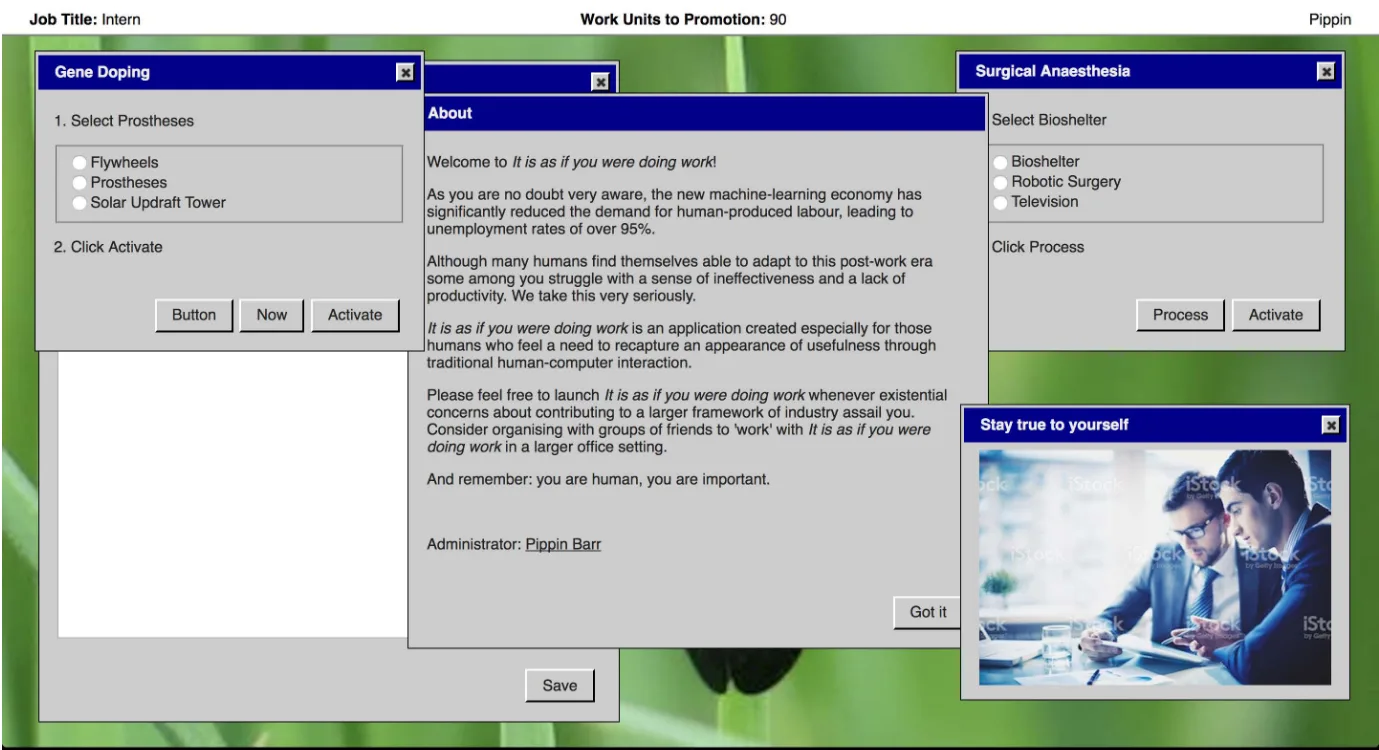
This late adoption of a background story could be interpreted as an argument favouring the superficial contribution of narrative to games. However, press coverage demonstrates the contribution of the story to Work’s interpretation: “I’ve been playing It Is As If You Were Doing Work on the same computer I use to do work during work hours, and I don’t quite know what’s real anymore. Time to hit this button marked ‘publish’ and see if I get any promotion points.” 7. Its influence on the design process should not be underestimated either.
Once Barr had committed to this story, it became a core structuring factor in following design decisions. For example, a lingering concern seemed to be the balancing of difficulty. A week earlier, he had written, “how hard is this meant to be??” 3. Level of difficulty is always a hard question for a designer to answer, as it is arbitrary and hinges on a clear understanding of the quality of experience being sought. Early versions of Work rely on a succession of prompts, as opposed to a single desktop environment, enforcing an intense pace on players. Dialog boxes asking the player to click a single button can be dealt with quickly, but others that require typing a specific sentence or setting a spinner to a given number require sufficient time and effort that completion is interrupted by new dialogs appearing. As they pile up, the play experience soon becomes overwhelming and stressful. This hectic rhythm remains in keeping with Barr’s initial WarioWare reference, materialising an aesthetic of intense productivity. The fast-paced versions of the game could in fact be interpreted as a very literal take on Janet Murray’s provocation that we can read Tetris as “the enactment of the overtasked lives of Americans” 8.
There are multiple factors that Barr finds difficult to settle: Should it be more of a continuous grind, or punctual, more intense challenges? How should actions be rewarded? Should players be punished for errors or simply be stalled until they succeed? How hectic should the pace be? At what interval should pop-up tasks appear?
What is a good length for each task? Ultimately these design questions are answered by making them consistent with the chosen narrative: this should feel like office work, so a level of effort is necessary, but the fictional application is ultimately designed to soothe, and so should not be too stressful. Barr chooses to not punish players, with errors simply leading to an opportunity to try again, but still requests a certain intensity from them, exploiting the ubiquitous familiarity of multi-tasking in contemporary computer-assisted work.
Footnotes
-
Pippin Barr. 2017. Press Kit for ‘It Is As If You Were Doing Work’. (2017). itisasifyouweredoingwork Press on GitHub ↩
-
Sebastien Wesolowski. 2017. “It is as if you were doing work”, un simulateur de travail pour un monde postemploi. (2017). vice.com/fr ↩
-
Pippin Barr. 2016-2017. ‘It is As If You Were Doing Work’ Process Diary. (2016-2017). README.md on GitHub ↩ ↩2 ↩3 ↩4 ↩5 ↩6 ↩7
-
Nintendo. 2003. WarioWare. WarioWare, Inc.: Mega Microgames!. (2003). ↩
-
Pippin Barr. 2017. ‘It is as if you were doing work’ screenshot of UI with placeholder text. (2017).Link of Asset in Repo ↩
-
Pippin Barr. 2017. ‘It is As If You Were Doing Work’ commit c0a887d890ffd2a0b2b2dbc34aa1a214f9d3b3e4. (2017). https://github.com/pippinbarr/itisasifyouweredoingwork/c0a887d8 ↩
-
James Vincent. 2017. Relive the Windows 95 glory days with this work simulation game. (July 2017). theverge.com ↩
-
Janet Horowitz Murray. 1997. Hamlet on the Holodeck: The Future of Narrative in Cyberspace. The Free Press, New York, NY, USA. ↩
